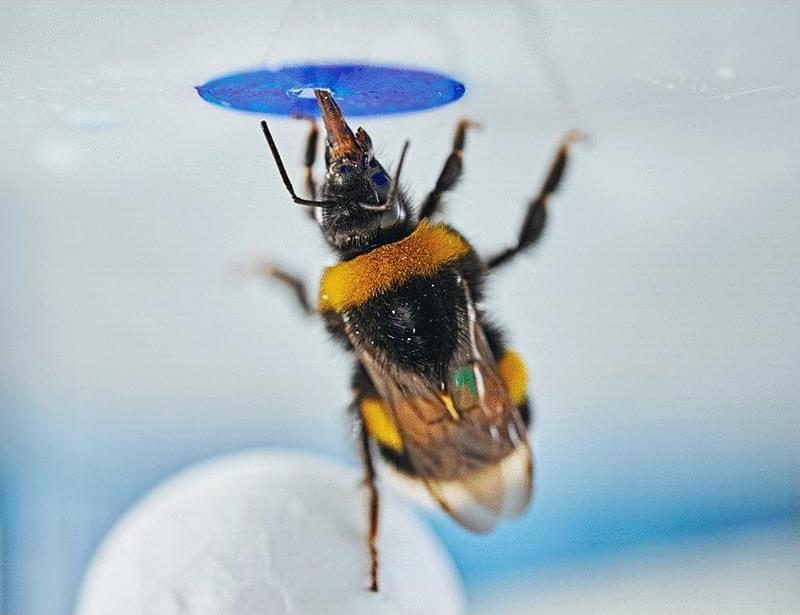
Problem-solving using novel solutions without explicit training is often considered a hallmark of cognitive flexibility. We investigated whether bumble bees (Bombus terrestris) could solve a novel object manipulation task spontaneously. Bees trained to associate a blue ring (“flower”) on the floor with a reward successfully moved a ball underneath a flower relocated to the ceiling to reach the flower. In control experiments in which the flower was out of sight when ball movement began and remained hidden during transport, bees still succeeded in the task. These results suggest that these were goal-directed actions rather than reinforcement-based associations driven by perceptual feedback. Our findings provide evidence that bumble bees can exhibit spontaneous problem-solving, challenging the notion that such advanced cognitive abilities are exclusive to large-brained vertebrates.