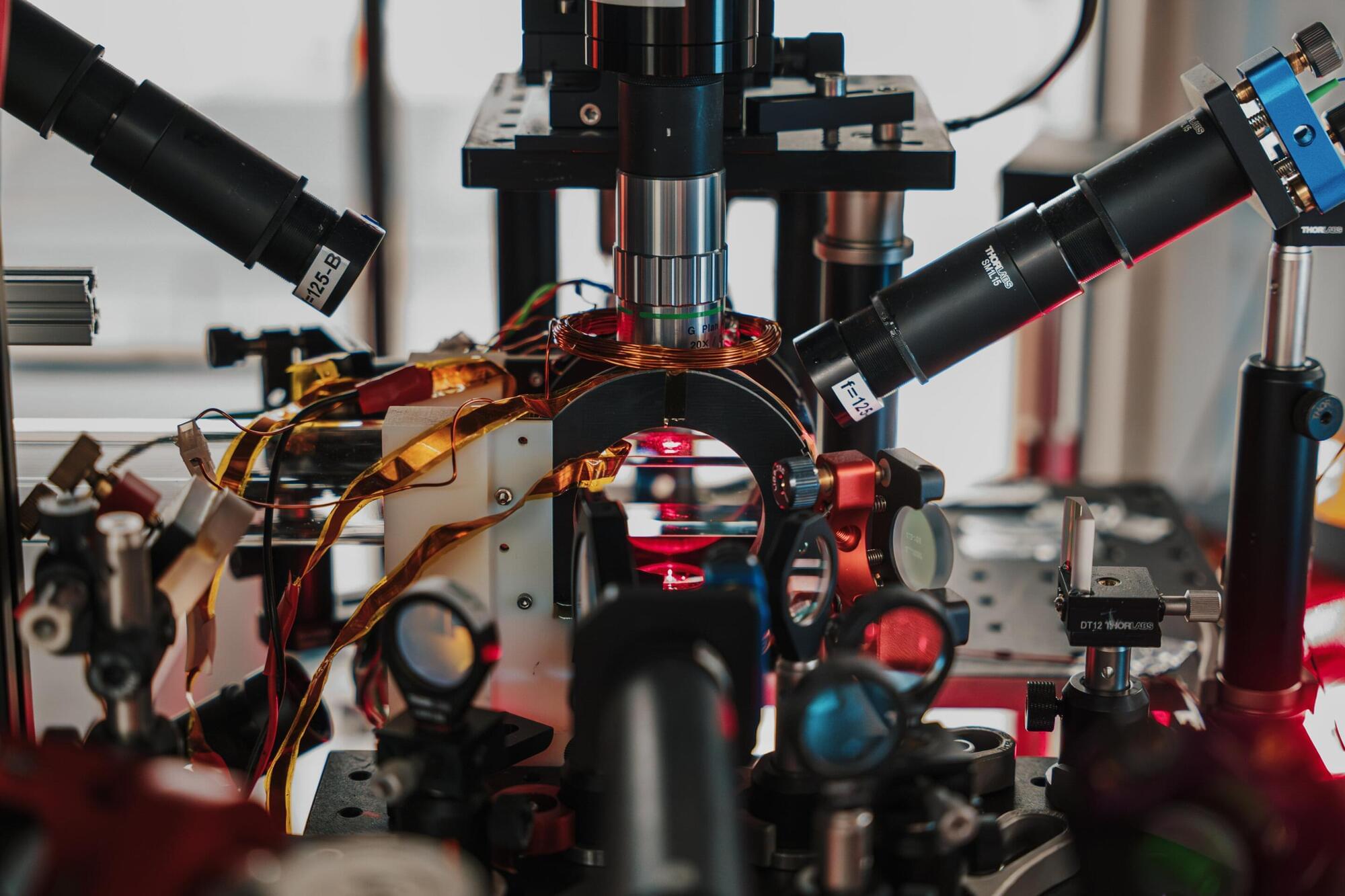
A University of Birmingham scientist has built a “mini-universe” that takes a step toward answering one of science’s biggest questions: “What is time?” Publishing his findings in Physical Review Research, Professor Giovanni Barontini shows how it is possible to measure the flow of time without using a clock at all. The new findings provide a scientific model in which a version of time emerges from the experiment itself.
Some theories of physics, such as the Wheeler–DeWitt equation, suggest that, at its deepest level, the universe has no built-in time but exists as a single, unchanging quantum state in which particles exhibit both wave-like and particle-like properties. It treats the universe as a whole with no external clock, and any sense of time must emerge from internal relationships between parts.
When we wind up the spring of a clock or when we insert a battery — we add energy to the clock-work.
Time pass by in a clock only then when we have a flow of energy in the clock-work — because every clock-work is working as a machine according to the laws of thermodynamics.
When this flow of energy is seen as the flow of time — then we can have the definition: Time is Energy
With the definition ´Time is Energy´ — we have an explanation/definition for the nature of time.
(book-source in German language: Kinseher Richard “Auflösung grosser Fragen: Was ist Bewusstsein? Was ist Zeit?” (= answers to the big questions: What is consciousness? What is time?) )
Our universe had the highest concentration of energy at the moment of the big-bang. Since then the amount of energy per volume is decreasing with the expansion of the universe:
This does mean that the universe is working as a machine according with the laws of thermodynamics: A flow of energy from a higher concentration/intensity towards a state of lower concentration/intensity