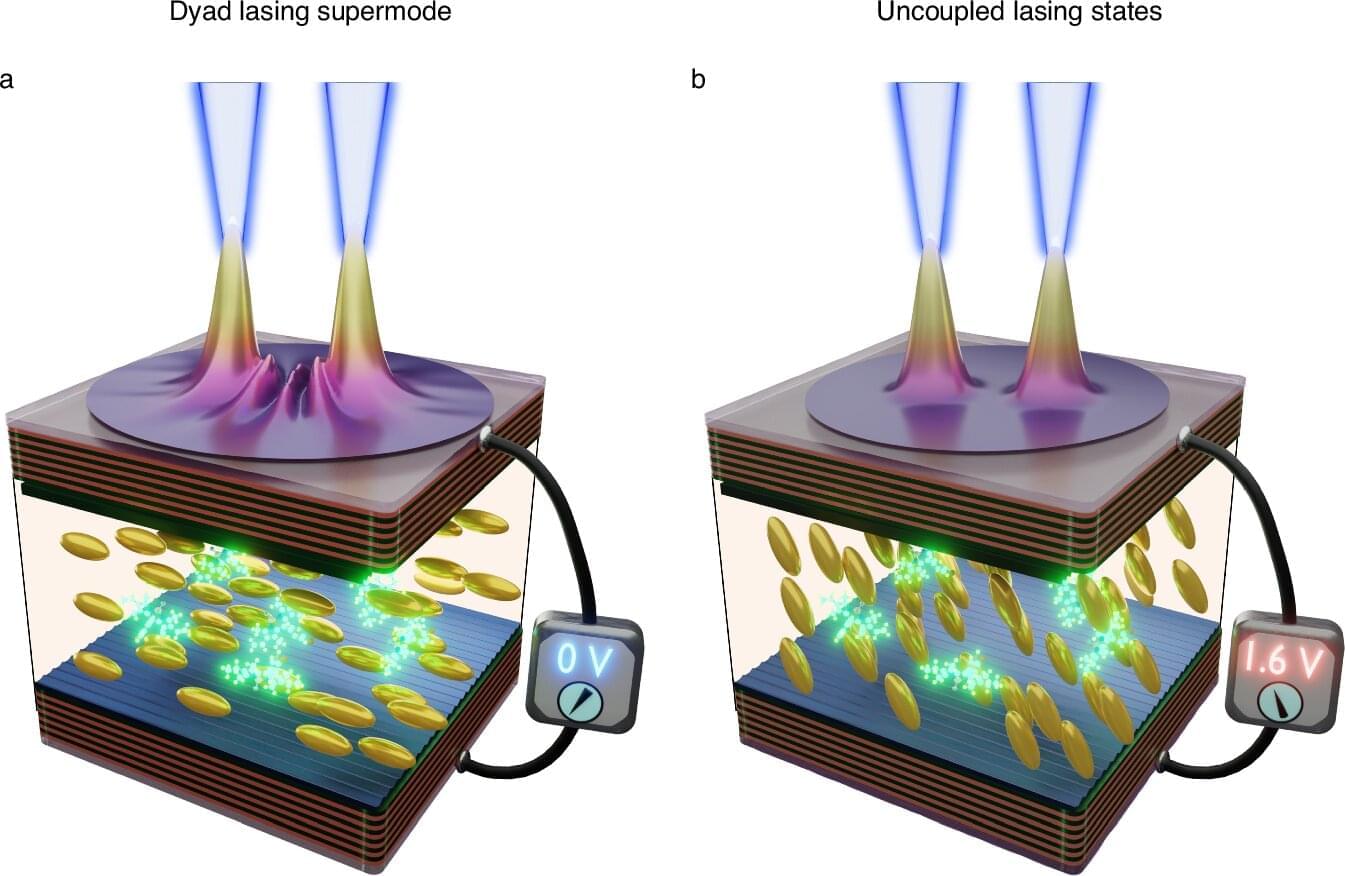
Researchers have demonstrated a new way to make spatially separated lasers synchronize and act as a single coherent light source—without extreme conditions or complex materials.
A team of physicists from the University of Southampton (UK), University of Warsaw (PL), Military University of Technology (PL), Institut Pascal, Université Clermont Auvergne, CNRS (FR), and CNR (IT) has developed a new class of tunable photonic devices in which multiple tiny laser beams spontaneously synchronize and behave as a unified, spatially extended and coherent light source. Remarkably, this effect is achieved at room temperature using a simple system based on liquid crystals and organic dye molecules, opening new possibilities for low-cost and reconfigurable optical technologies.
The work is published in the journal Nature Communications. The study demonstrates that spatially separated laser spots inside an optical microcavity can spontaneously phase-lock—that is, align (or synchronize) their oscillations—and form a collective state known as a “supermode.” Traditionally, such behavior has been observed only in highly specialized semiconductor systems operating at cryogenic temperatures and in the so-called strong light-matter coupling regime.