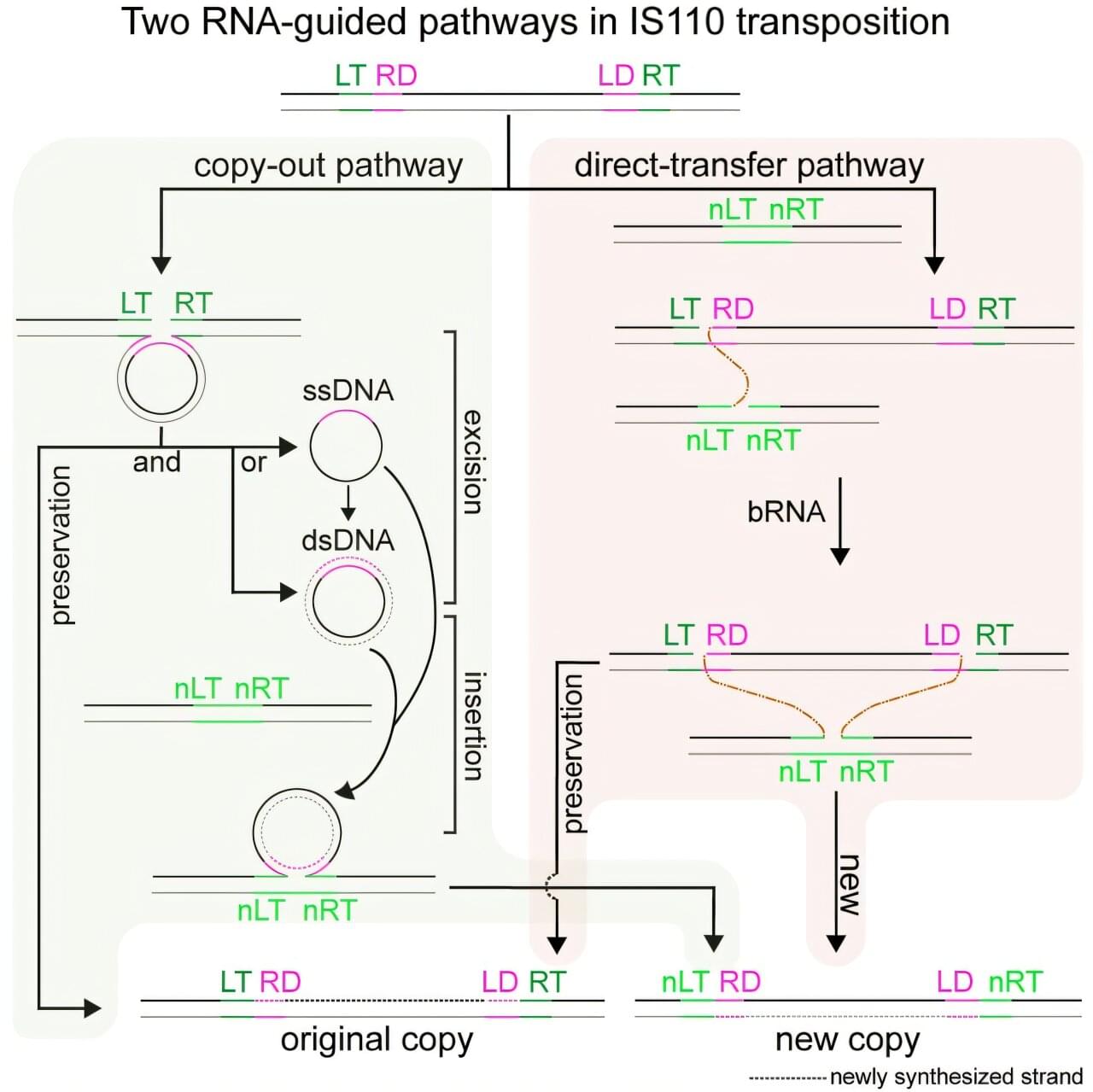
IS110 transposons are a large, diverse family of bacterial insertion sequences (IS elements)—small, mobile DNA elements that can move from one genomic location to another. They have recently attracted broad interest due to the finding that some of these transposons use a bridge RNA (bRNA) to recognize both donor DNA and target DNA.
Upon this discovery, researchers hoped that bRNA-guided transposon systems could offer a genome-editing strategy distinct from classical CRISPR-Cas nucleases and thereby enable programmable DNA integration. However, it remained unclear how IS110 elements insert donor DNA into target sites and whether these elements rely on one or multiple reaction pathways.
Now, a new study led by Xue Chaoyou from the Tianjin Institute of Industrial Biotechnology of the Chinese Academy of Sciences, in collaboration with Lou Huiqiang at China Agricultural University and RAO Shuquan from the Chinese Academy of Medical Sciences, answers these questions by showing that RNA-guided IS110 transposons use two mechanistically distinct pathways to mobilize DNA.