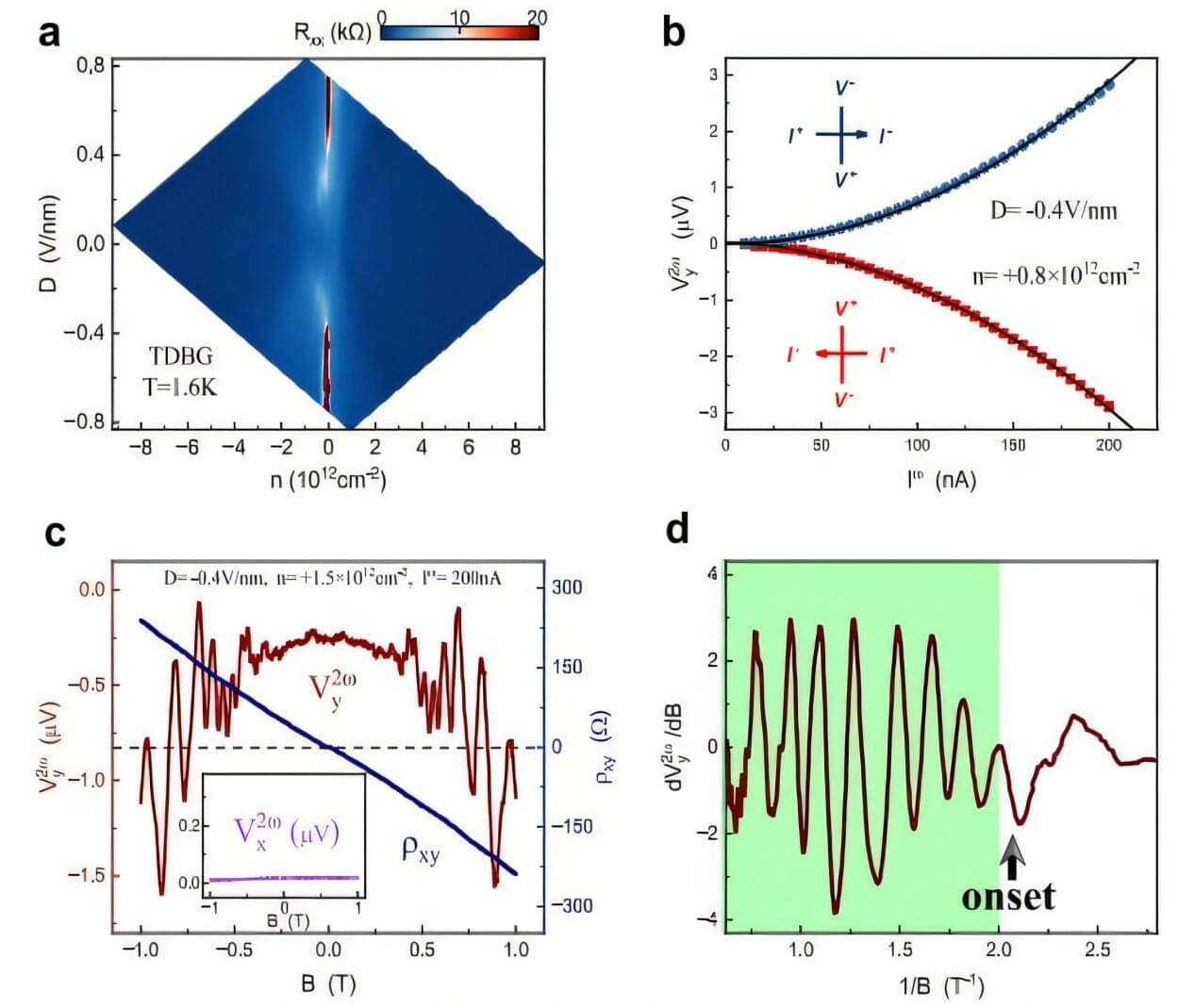
Physicists have long been drawn to the nonlinear Hall effect: a subtle variant of the classical Hall effect, in which an electric voltage appears perpendicular to a current flowing through a material. Unlike its classical counterpart, the nonlinear version can arise even without breaking time-reversal symmetry, and its magnitude is tied to deep geometric properties of electron wave functions. So far, however, the behavior of the effect when a magnetic field is applied has remained poorly understood.
Through new research published in Physical Review Letters, a team led by Jinrui Zhong at the Beijing Institute of Technology has shed new light on this question—leading them to discover an entirely new class of quantum oscillation.