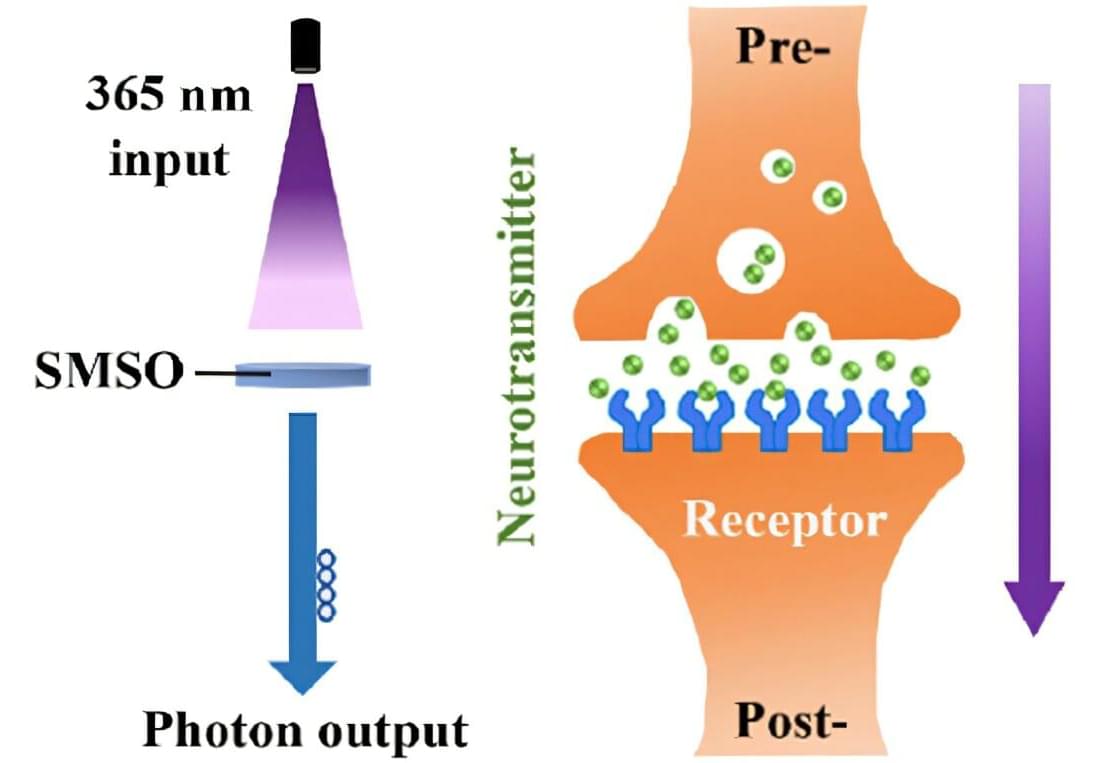
Modern artificial intelligence systems rely on moving large amounts of data between memory and processors, a design that limits speed and increases energy use. The human brain works differently: it combines memory and computation within synapses, allowing fast, efficient learning and perception. Replicating this approach in hardware is a central goal of neuromorphic computing, especially for tasks like vision, where most real-world information is gathered and processed.
In that context, researchers have developed a new type of artificial synapse that operates entirely with light. Unlike most existing devices, which still depend on electrical signals at some stage, this system uses optical signals both to receive information and to update its internal state. Removing electrical conversion steps could lower energy use, reduce noise, and enable faster processing, particularly in vision systems that already rely on light.
As reported in Advanced Photonics, the device is built from a rare-earth-doped crystal that emits a persistent afterglow after being illuminated. This material can store optical information in the form of trapped charge carriers. When light excites the crystal, some of these carriers emit light immediately, while others remain trapped and are released later. The balance between these pathways depends on the history of illumination, allowing the material to mimic how biological synapses change strength based on past activity.