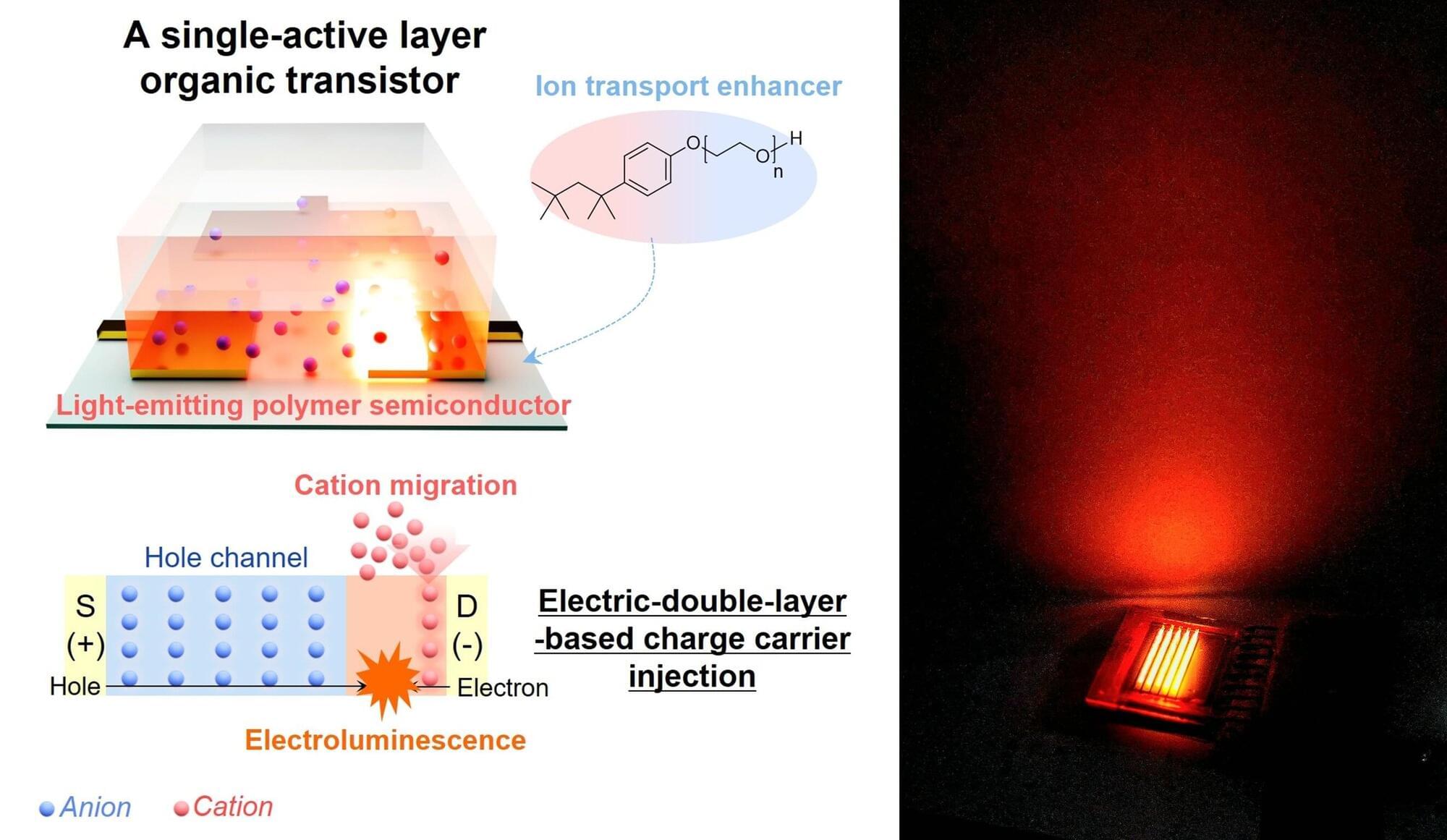
Seoul National University researchers have developed an ultra-low-voltage electrochemical organic light-emitting transistor that can simultaneously perform signal processing, memory and light emission within a single semiconductor device. By introducing an ion-transport enhancer into the light-emitting polymer semiconductor channel, the team enabled electric-double-layer formation at the drain electrode interface, allowing efficient electron injection without relying on the high voltages or unstable n-type doping used in conventional approaches.
As a result, the device maintained a simple single-active-layer structure while achieving both low-voltage operation and wide, spatially pinned light emission, together with neuromorphic signal-processing functionality.
The work is published in the journal Nature Materials.
The ability to combine memory, signal processing, and light emission in a single organic transistor operating below 3.5V is remarkable. This kind of multifunctional integration at the hardware level has interesting parallels in AI, where multi-modal models combine text, image, and audio processing in unified architectures. The efficiency gains here remind me of how AI image generation has gotten dramatically better at producing high-quality outputs with fewer computational resources. Both fields are pushing toward doing more with less.