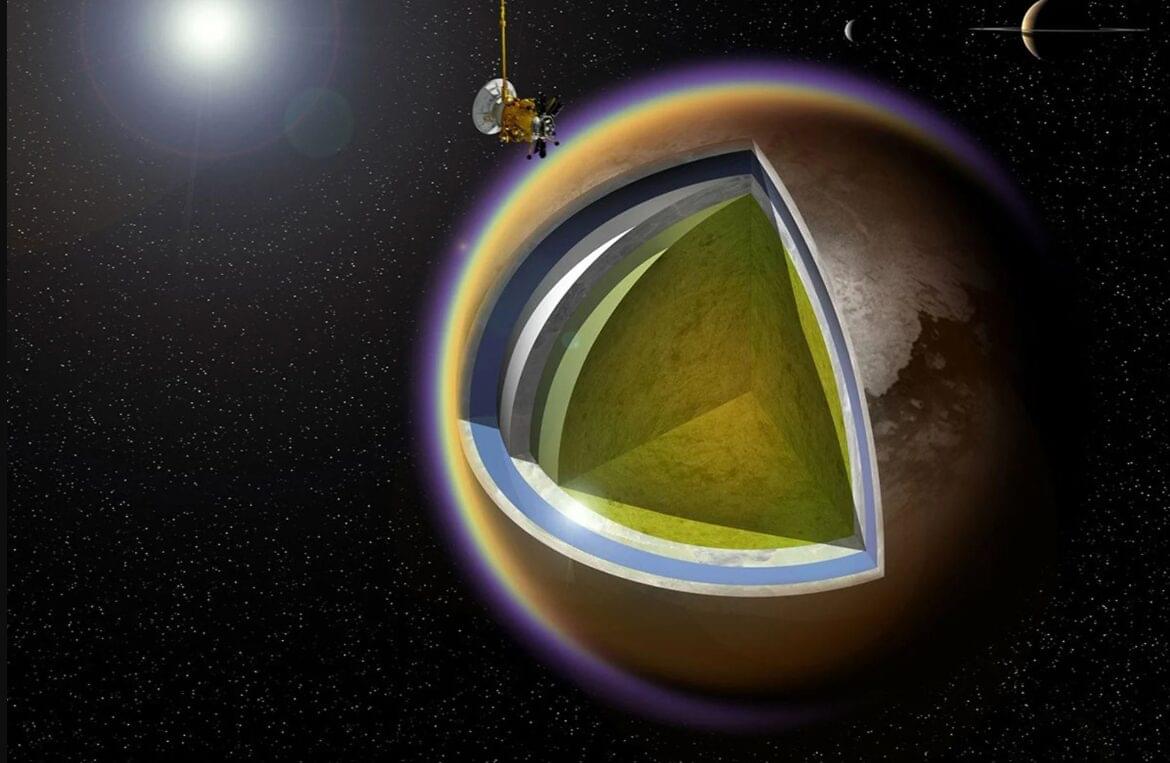
Saturn’s largest moon, Titan, is a unique environment in our solar system. It is the only moon (or body beyond Earth) to have a dense, nitrogen-rich atmosphere, and its methane cycle is very similar to Earth’s hydrological cycle, in which solid and liquid methane evaporate to form clouds and return to the surface as precipitation. In addition, its prebiotic surface environment and rich organic chemistry make it a prime destination for astrobiology missions, such as NASA’s Dragonfly mission (set to launch no earlier than July 2028).
And as Robert Zubrin said in his book, “Entering Space: Creating a Spacefaring Civilization,” Saturn’s moons could become the “Persian Gulf” of the solar system, with Titan a major one because of its rich resource environment. In a recent NASA-supported study posted to the arXiv preprint server, a team of researchers compiled an inventory of Titan’s resources and their potential use by future generations of humans. When comparing this satellite with other destinations (i.e., the moon and Mars), they conclude that Titan offers several potential benefits for human settlement.
The research was led by Conor A. Nixon, an astronomer and planetary scientist with the solar system Exploration Division (SSED) at the NASA Goddard Space Flight Center and the associate laboratory chief of its Planetary Systems Laboratory. He was joined by Ye Lu, a professor of aerospace engineering at Worcester Polytechnic Institute, and Jennifer E. Ruliffson, a professor of Materials Science and Engineering at the University of Florida. Their paper is under review for publication in Acta Astronautica.