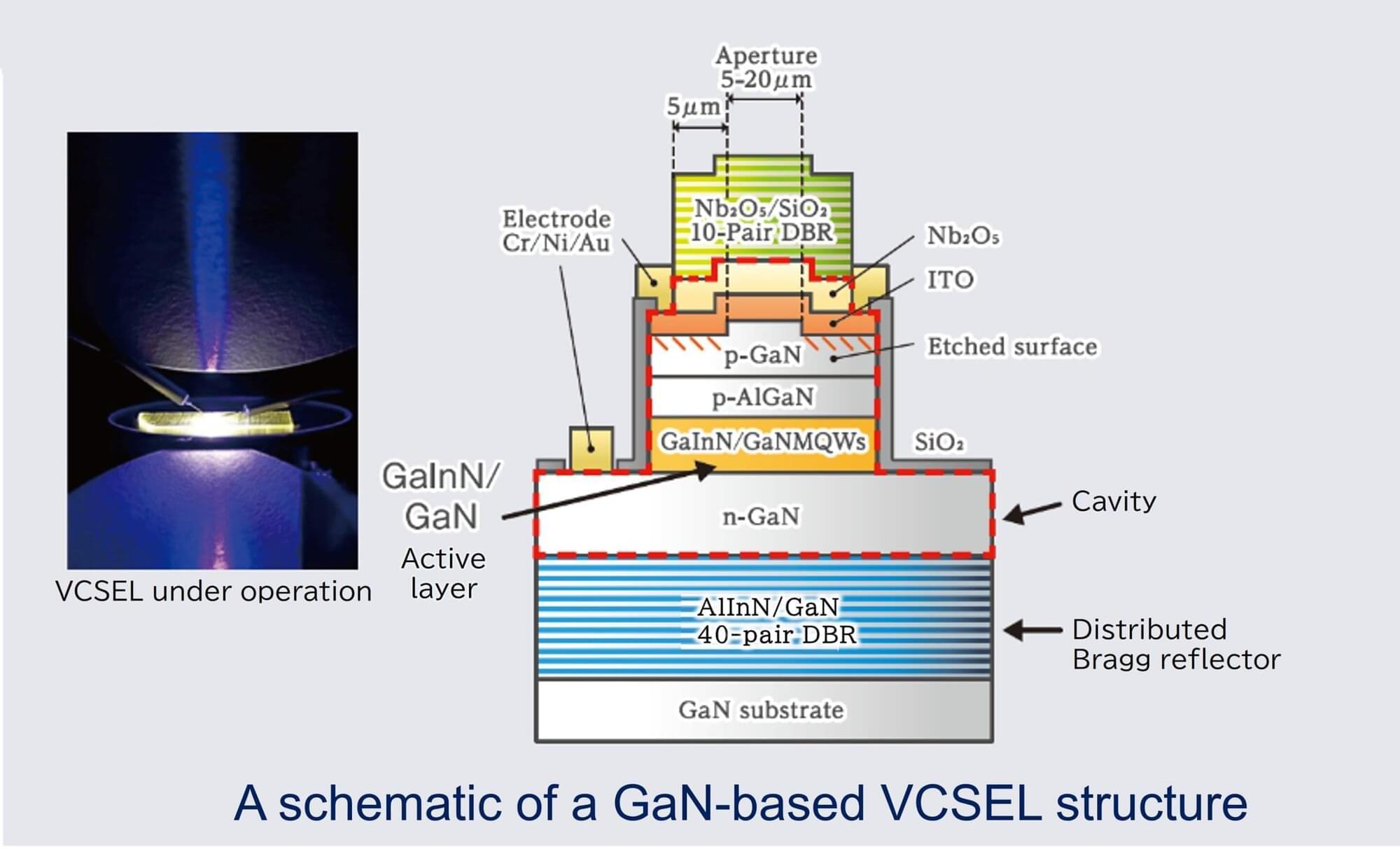
GaN-based vertical-cavity surface-emitting lasers (VCSELs) are promising for displays, sensing and optical communication, but improving efficiency remains challenging. Researchers have now shown that “cavity tuning,” which controls resonance wavelength, strongly affects laser performance. By analyzing variations across a VCSEL wafer, the team identified optimal mirror loss conditions and extracted device parameters. Their approach achieved 26.4% wall plug efficiency, offering guidance for next-generation high-efficiency visible-light semiconductor lasers.
Gallium nitride (GaN)-based vertical-cavity surface-emitting lasers, or VCSELs, are attracting increasing attention as compact and energy-efficient light sources for future technologies. These semiconductor lasers are considered promising for applications such as next-generation displays, biometric sensing, environmental monitoring and short-range optical communication. However, improving their efficiency has remained a major challenge because laser performance depends strongly on precise optical design and cavity control.
Addressing this challenge, a research team led by Professor Tetsuya Takeuchi, Professor Satoshi Kamiyama and Professor Motoaki Iwaya from the Department of Materials Science and Engineering, Meijo University, Japan, along with Mr. Naoki Shibahara, first author and graduate student at the Graduate School of Science and Technology, Meijo University, Japan, investigated how “cavity tuning” influences the lasing characteristics of GaN-based VCSELs. While conventional studies mainly focused on gain tuning, also known as detuning, the researchers demonstrated that resonance wavelength alignment relative to the distributed Bragg reflector center wavelength critically affects laser operation.