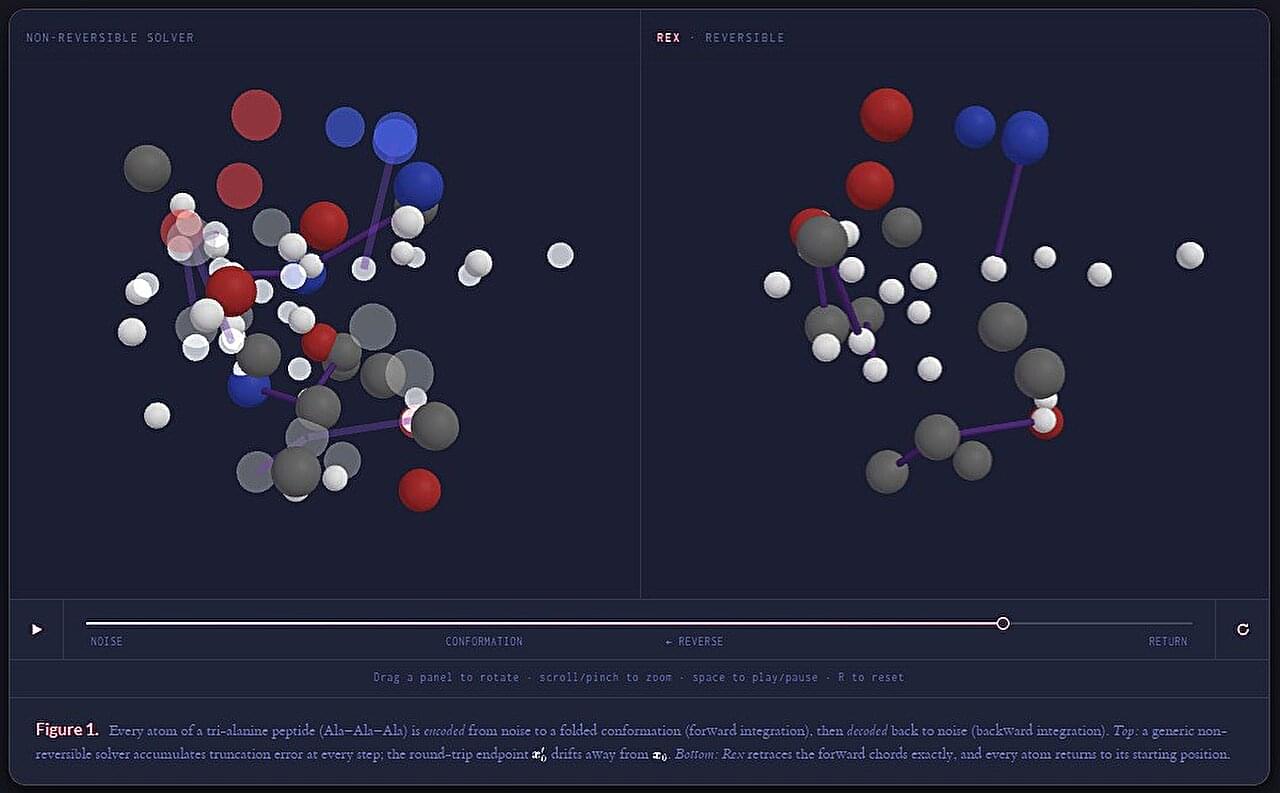
Clarkson University researchers have developed a new mathematical tool that could make artificial intelligence systems more accurate, controllable and useful across applications ranging from image editing to drug discovery.
Clarkson University postdoctoral researcher Zander Blasingame and Chen Liu, professor of electrical and computer engineering, created a new family of numerical solvers called Rex that improves how generative AI models move between random noise and meaningful data. Their work, “Rex: A Family of Reversible Exponential (Stochastic) Runge-Kutta Solvers,” will be presented this summer at the International Conference on Machine Learning (ICML 2026), and an earlier version of the paper is available on the arXiv preprint server.
Diffusion and flow-matching models are the foundation of many modern generative AI systems, including image generators, molecular design tools and scientific simulators. They work by gradually transforming random noise into useful outputs. While that process is effective for creating new content, many important applications require running it in reverse. Existing methods often introduce errors that make it difficult to accurately recover the original information.