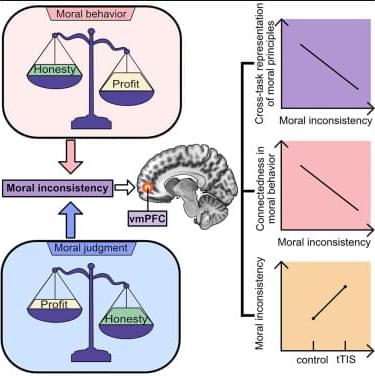
A new Cell Reports study looked at why people sometimes judge others harshly for dishonest behavior while excusing similar behavior in themselves. The researchers call this moral inconsistency: a mismatch between the moral standards someone uses to judge others and the standards they apply to their own behavior. The study used an honesty-versus-profit task, where participants could gain money by being dishonest, and then judged both their own behavior and other people’s behavior.
The main finding was that people who were more morally inconsistent showed weaker involvement of the ventromedial prefrontal cortex, or vmPFC, a brain region involved in value-based decision-making, social judgment, emotion regulation, and moral evaluation. In morally consistent participants, the vmPFC seemed to represent moral judgment more similarly across “judging myself” and “judging others.” In morally inconsistent participants, that cross-task representation was weaker, especially when they were making choices for themselves.
Liu. V, et al. find that moral inconsistency arises from a reduced ability of the vmPFC to form a cross-task representation of moral principles and its connectedness during the moral behavior task. This indicates that individuals with higher moral inconsistency consider moral principles less often to guide their own behavior.