Magnetoelectric microrobots for spinal cord injury regeneration
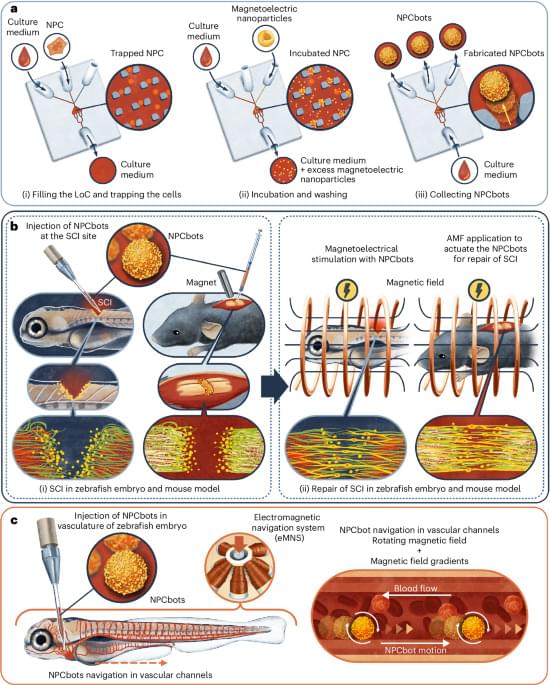
Microrobots made of human-induced pluripotent stem cells and magnetoelectric nanoparticles promote lesion repair and motor improvements after spinal cord injury in zebrafish and mice under magnetic guidance and stimulation.
3 Comments so far
This is fascinating research on magnetoelectric microrobots for spinal cord regeneration. The combination of human-induced pluripotent stem cells with magnetoelectric nanoparticles is incredibly innovative. I work with AI image generation tools at nanobananapro.pics and it is amazing to see how biotech and nanotechnology are converging with computational approaches to solve medical challenges. The zebrafish and mice model results are very promising for future clinical applications.
The study, published June 2, 2026, in Nature Materials, demonstrates promising results in animal models only: rapid recovery in zebrafish and significant motor improvements in mice with severed spinal cords.
No human clinical trials have started. Researchers explicitly note that further work is needed, including larger animal studies, long-term safety/toxicity testing, optimization of magnetic fields for humans, scalability, and regulatory hurdles before human testing.
This is fascinating research on magnetoelectric microrobots for spinal cord regeneration. The combination of human-induced pluripotent stem cells with magnetoelectric nanoparticles is incredibly innovative. I work with AI image generation tools at nanobananapro.pics and it is amazing to see how biotech and nanotechnology are converging with computational approaches to solve medical challenges. The zebrafish and mice model results are very promising for future clinical applications.
Great news but who is doing this work?
The study, published June 2, 2026, in Nature Materials, demonstrates promising results in animal models only: rapid recovery in zebrafish and significant motor improvements in mice with severed spinal cords.
No human clinical trials have started. Researchers explicitly note that further work is needed, including larger animal studies, long-term safety/toxicity testing, optimization of magnetic fields for humans, scalability, and regulatory hurdles before human testing.