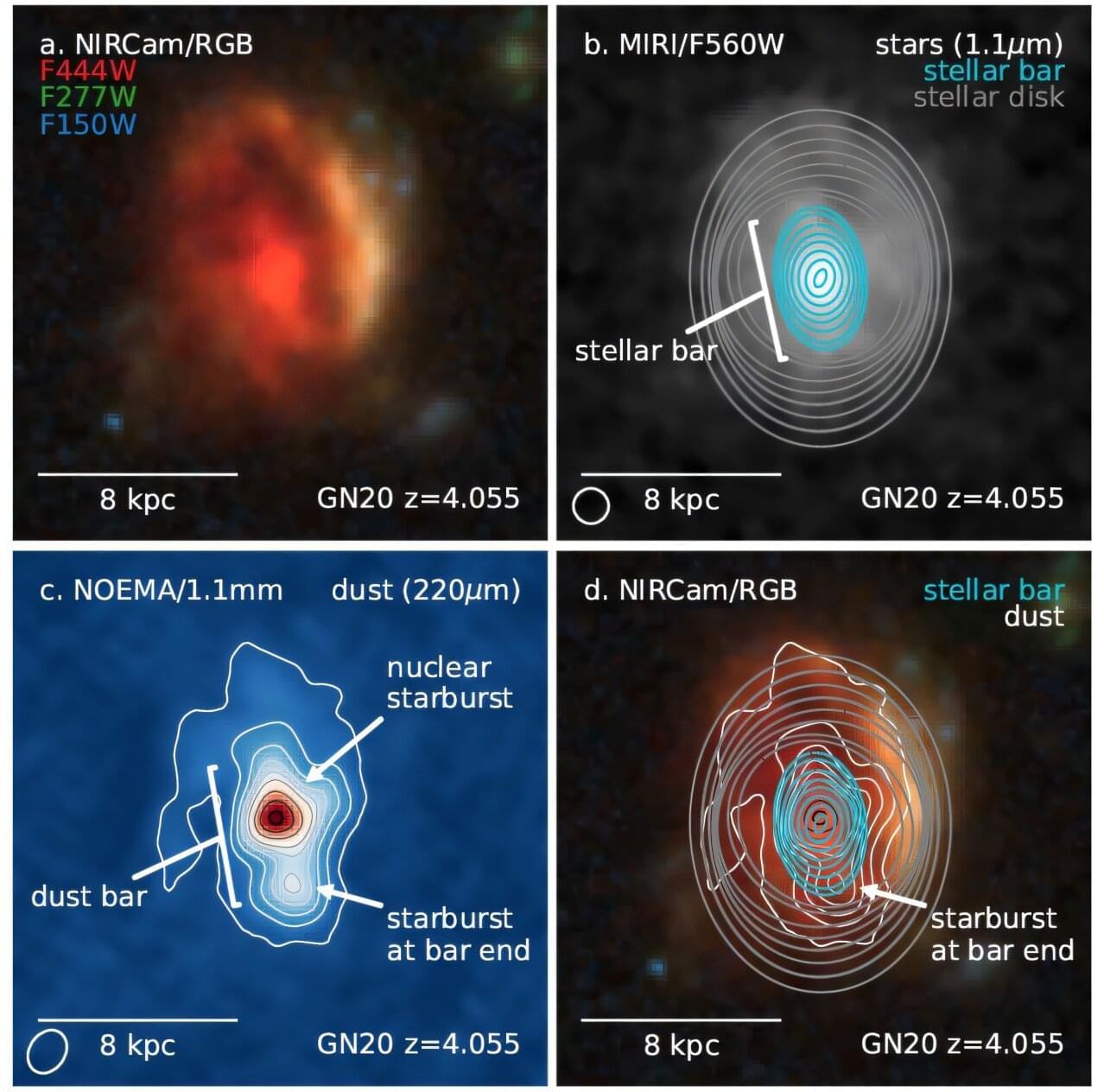
Astronomers using the James Webb Space Telescope (JWST) have discovered a stellar bar in GN20, a massive galaxy seen just 1.5 billion years after the Big Bang. The new paper was submitted to the preprint server arXiv on May 14.
Stellar bars are elongated arrangements of stars that cut across the center of a galaxy, rotating as a single rigid unit. As they spin, they act like a funnel and pull gas inward toward the galaxy’s nucleus, which can trigger intense star formation, feed the central black hole, and build up a dense core. In the nearby universe, bars are common. Even the Milky Way hosts one.
But formation of a stellar bar is thought to be slow, taking place over billions of years. Early galaxies were also significantly gas-rich, and gas was thought to suppress or delay bar formation. Therefore, when JWST discovered stellar bars within the first 2 billion years after the Big Bang, it challenged expectations from the standard model.