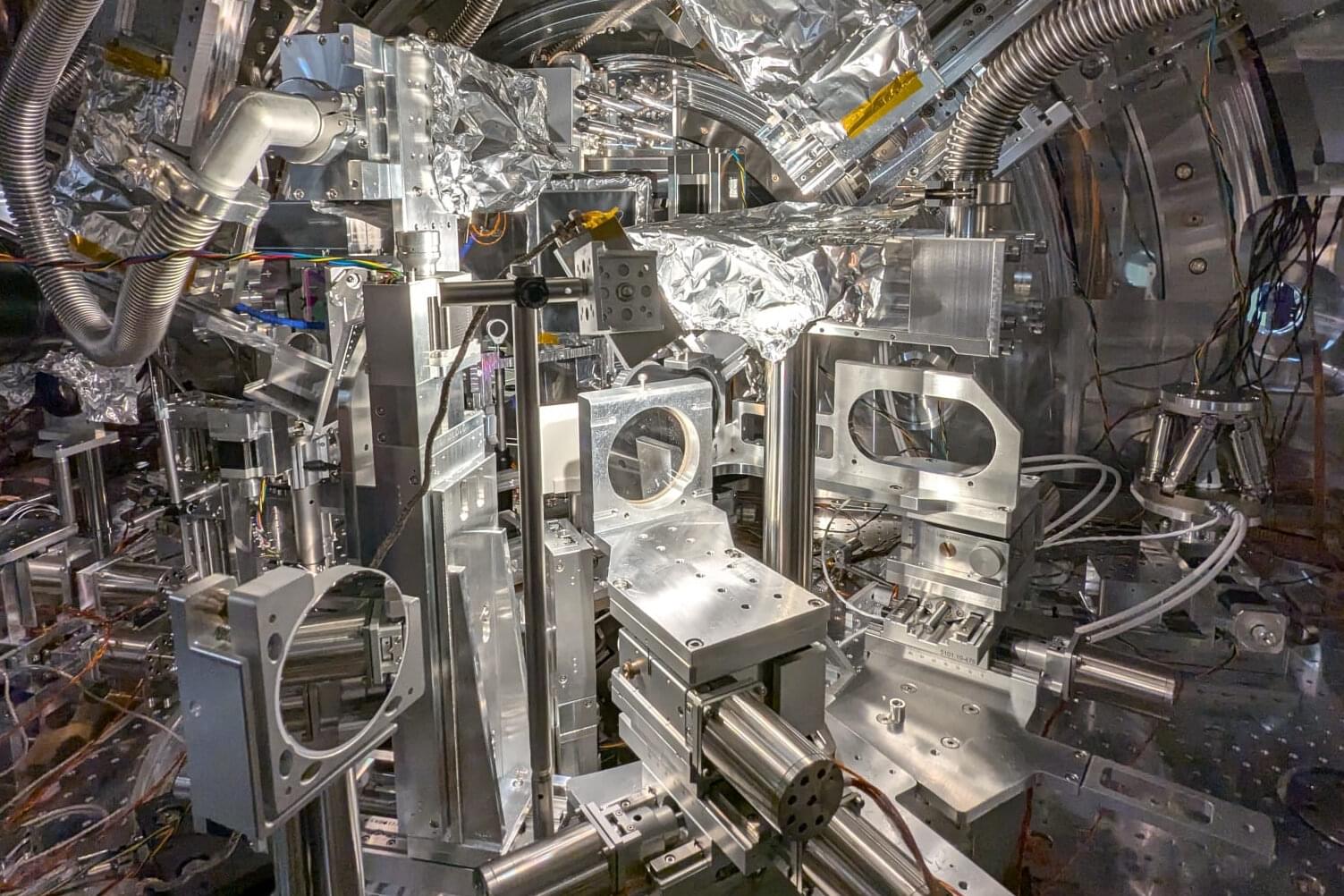
Researchers at European XFEL, Helmholtz-Zentrum Dresden-Rossendorf (HZDR), Rostock University and other collaborating institutions have used high-precision experiments to demonstrate that the most widely used models for the behavior of electrons in warm dense matter are inaccurate. Warm dense matter is challenging to study, but also is of key importance for a plethora of research, including the investigation of planetary interiors, materials science and laser fusion experiments. The study is published in Physical Review Letters.
In warm dense matter, electron density oscillates. The collective oscillations are called plasmons. They carry important information and can be observed using X-rays, resulting in scattering spectra—abstract images captured by a detector. In many experiments, these spectra are interpreted using simplified uniform electron gas models. However, the new measurements show that for warm dense aluminum, these models consistently overestimate the plasmon energy by up to about 25% (about 8 electronvolts) and fail to reproduce the full measured shape of the signal.
“Our measurements are precise enough to clearly distinguish between competing models,” says Dr. Thomas Preston of European XFEL. “That is important because these models are widely used to diagnose extreme states of matter. If the model is incorrect, that leads to inaccurately inferred properties.”