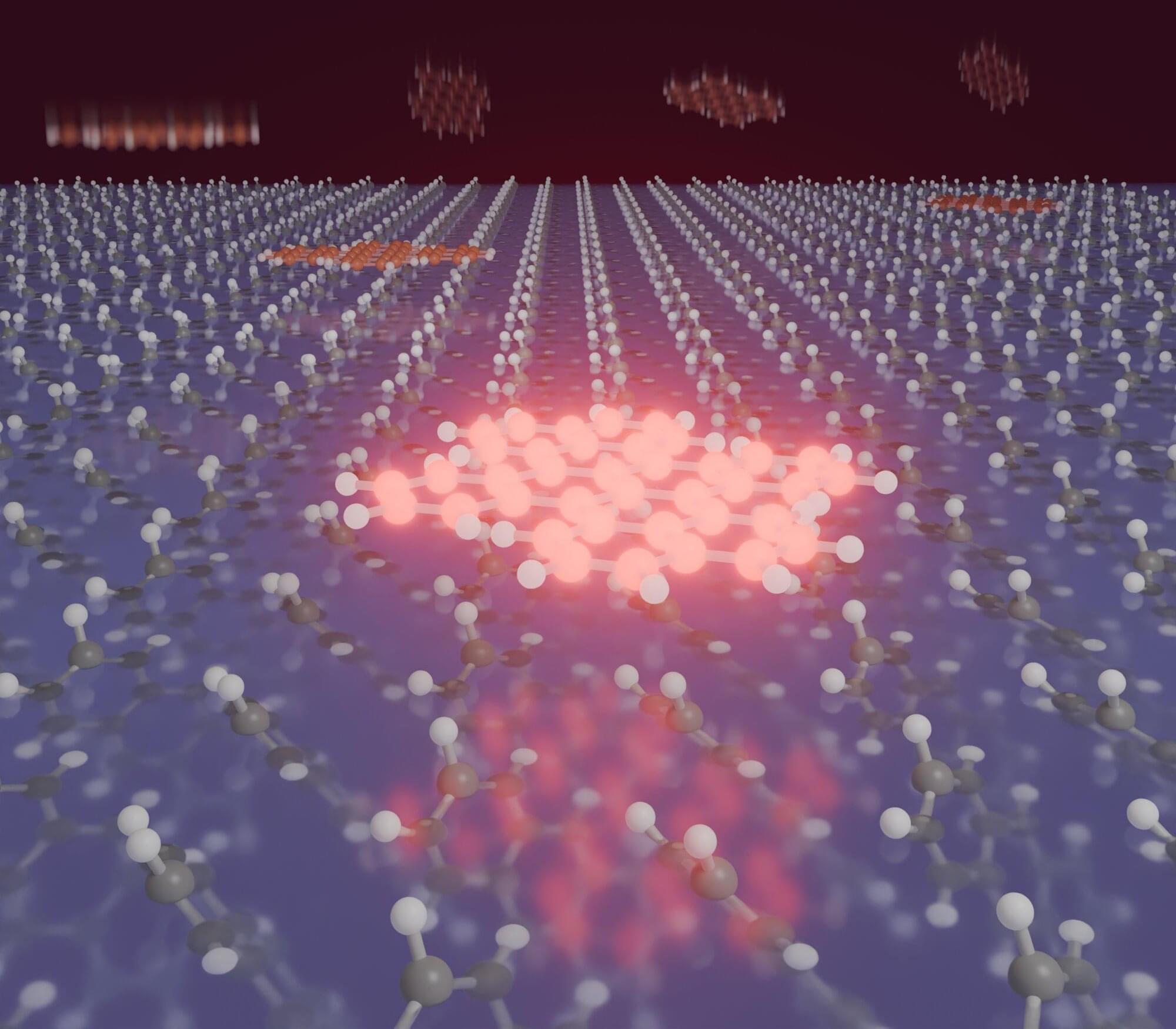
Scientists at the Max Planck Institute for the Science of Light (MPL) have developed a technique for interrogating molecules on surfaces with spectroscopic precision, thereby reaching the ultimate quantum limit for the first time. With their findings, published in Science, the researchers open new opportunities for the study of molecule-surface interactions and molecular quantum technologies.
Many optical quantum technologies rely on nanoscale objects, such as atoms or molecules, that interact strongly with light. These quantum emitters are used for generating single photons, storing quantum information and entanglement distribution, processes that find application in quantum communication and computation.
To investigate these emitters individually, researchers need to keep them in one place for a long time. This is usually achieved by either trapping them in a vacuum or placing them inside a bulk material. Quantum emitters located on a surface would create new opportunities to manipulate their functionalities by “touching them,” for example, with an atomically sharp tip, as is used in scanning tunneling microscopy (STM) and atomic force microscopy (AFM).