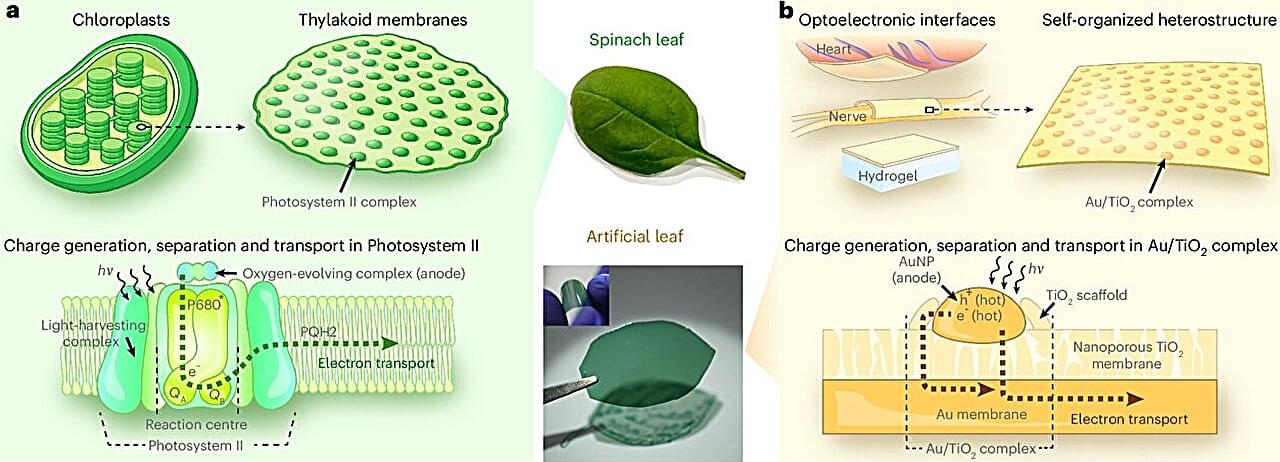
Plants convert light into energy efficiently through photosynthesis—an ability that scientists and engineers still struggle to match with electronic devices. Recently, researchers have looked beyond traditional semiconductor materials to create devices using a promising class of materials called nanoplasmonics. These tiny metal structures can absorb and concentrate optical energy and generate energetic charge carriers.
In a new study, researchers from the University of Chicago Pritzker School of Molecular Engineering (UChicago PME) and Department of Chemistry developed a nanoplasmonic “leaf,” a wireless bioelectronic device they used to stimulate nerves and pace heartbeats in an animal model.
The team also showed that their material could be used as a computer-like sensing platform, where users can interact with the screen using invisible light—a potentially secure way to transmit information.