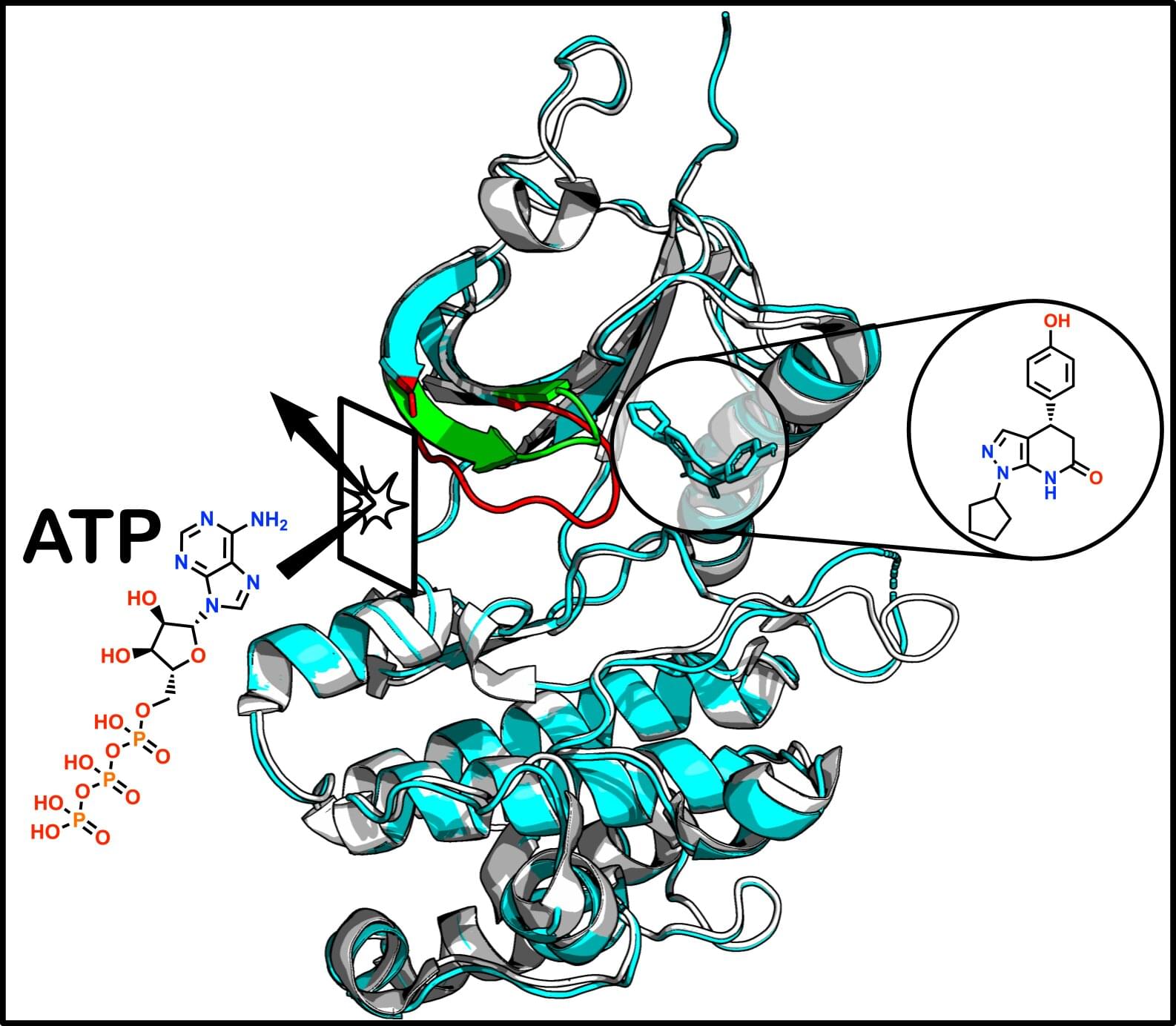
Researchers at the Icahn School of Medicine at Mount Sinai have identified a previously hidden druggable site in a cancer-related protein that could open the door toward the development of a new generation of more precise cancer drugs. The finding also reveals important limitations in today’s artificial intelligence tools for drug discovery.
The study, published in the June 2 online issue of the Journal of the American Chemical Society, focused on PKMYT1, a type of protein known as a kinase that helps control how cells grow and divide. Because this process can go wrong in cancer, PKMYT1 has emerged as a promising target for new cancer drugs.
Most experimental drugs designed to block kinases work by targeting a region called the ATP-binding site—the part of the protein that uses the cell’s energy supply to function. But many kinases share nearly identical ATP-binding sites, making it difficult for drugs to distinguish between the desired target and other kinases, which can lead to unwanted side effects.
This is a really important finding. The gap between AI-predicted drug targets and validated ones is a crucial reminder that AI is a powerful hypothesis generator, not a replacement for experimental validation. We see similar dynamics in AI-generated content tools, where the output always benefits from human review and refinement. Excited to see how the field matures as these computational and experimental workflows become more tightly integrated.