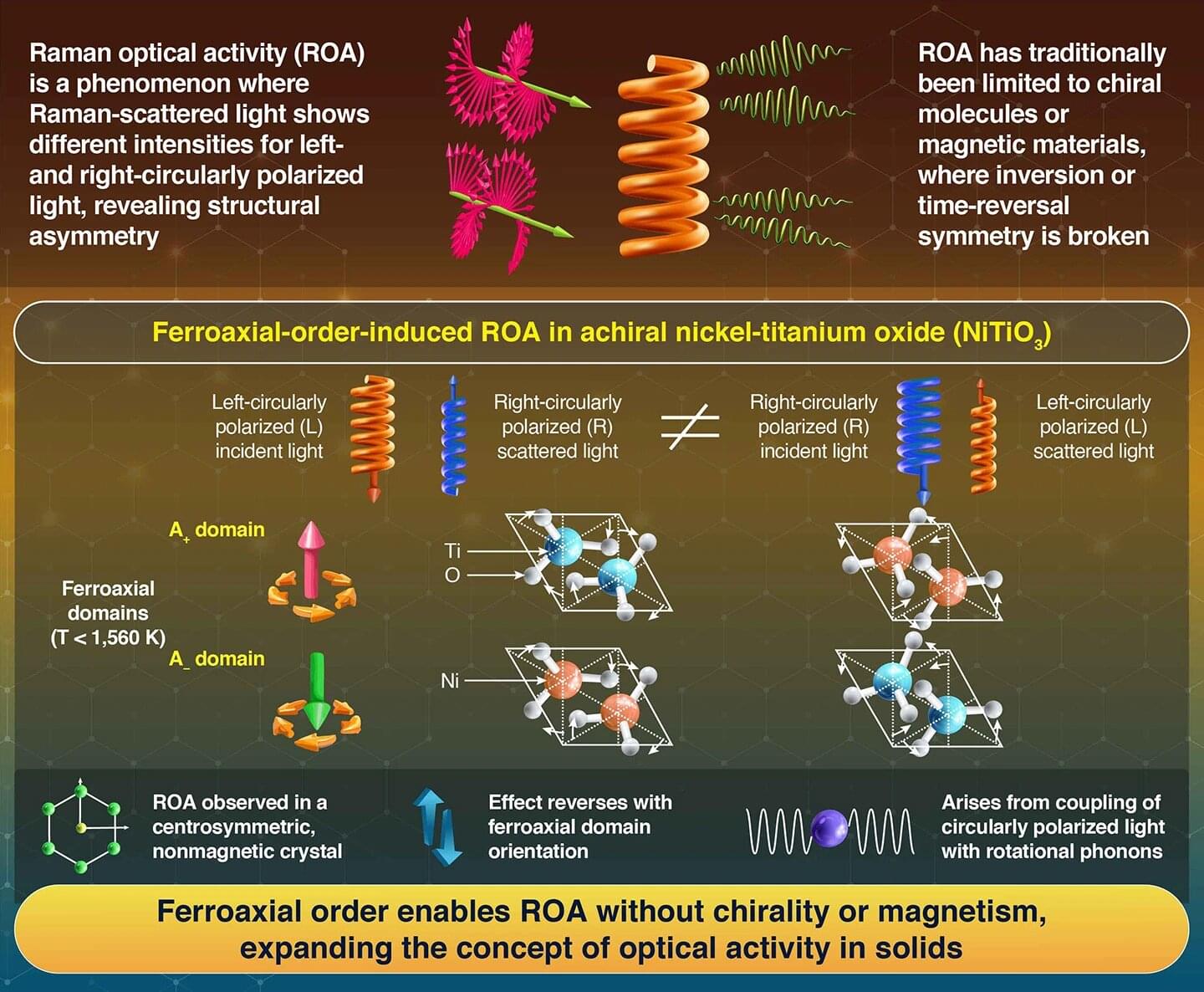
Raman optical activity, long thought to require chiral molecules or magnetic order, has been demonstrated in an achiral, nonmagnetic crystal by researchers at the Institute of Science Tokyo. The effect arises through ferroaxial order, a coordinated rotation of atoms within the lattice, and is detected using circularly polarized Raman spectroscopy. The findings show that optically inactive materials can also display chirality-like optical responses and expand the scope of optical techniques for discovering new materials.
In nature, molecules can be divided into two categories based on their symmetry: chiral and achiral. Chiral molecules are not identical to their mirror images, much like left and right hands. Achiral molecules, by contrast, are identical to their mirror images and therefore do not possess a definite handedness.
Light offers a way to distinguish between these two types. When light interacts with a chiral molecule, the response depends on its handedness. For example, chiral molecules absorb left-and right-circularly polarized light to different extents, a phenomenon known as circular dichroism. They also scatter these two types of light with different intensities, an effect called Raman optical activity (ROA), which is widely used to identify chirality. ROA has long been associated only with chiral molecules or with materials that have magnetic order, where inversion or time-reversal symmetry is broken.