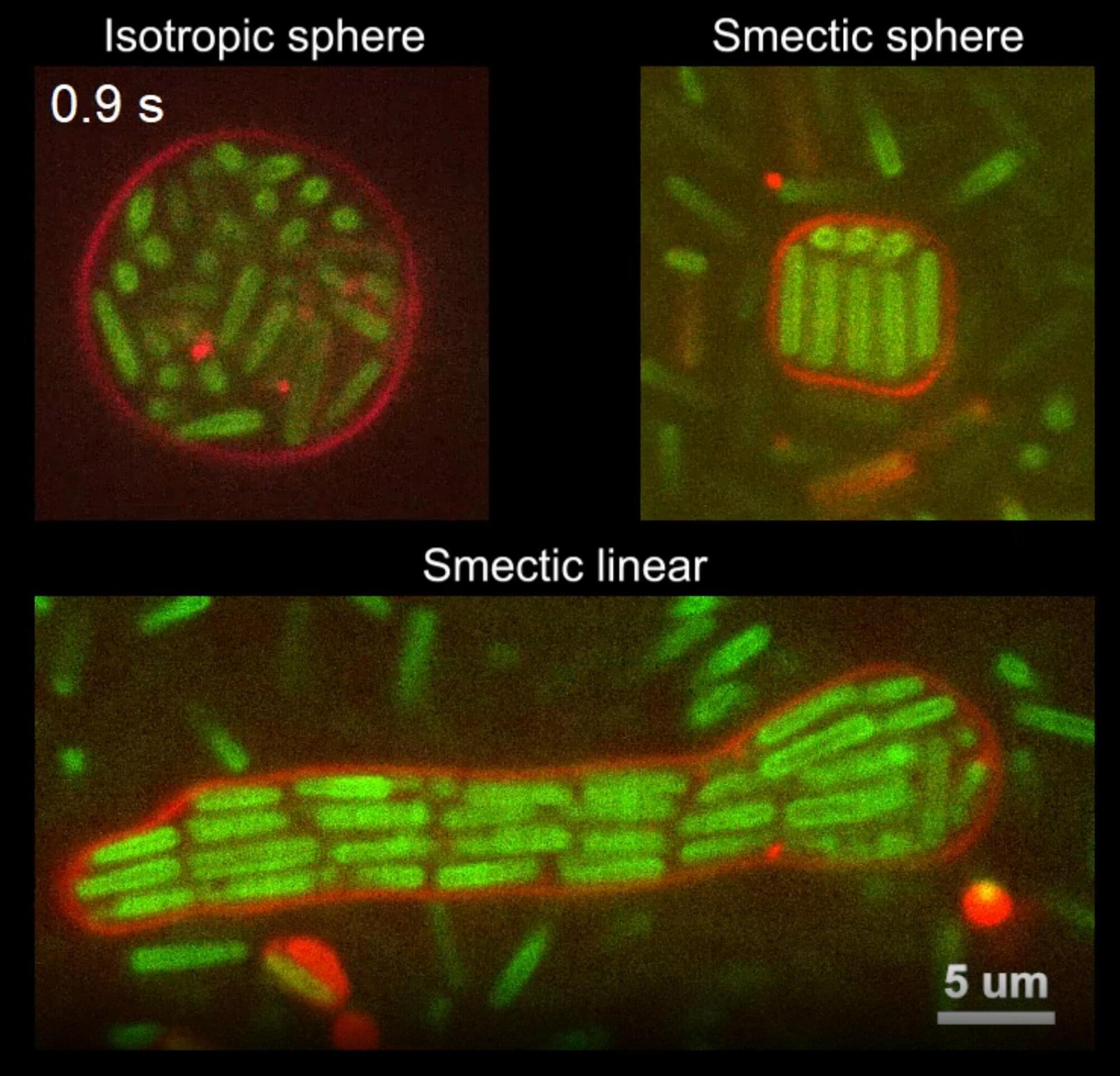
Researchers at the University of Twente and Utrecht University have packed rigid, rod-shaped particles into soft lipid containers the size of a living cell and watched the container and its contents reshape each other. The vesicle’s form determines how the rods line up; the tightly packed rods, in turn, bend the container into new shapes. This provides a minimal model for how physical coupling between a soft boundary and internal filaments can help cellular structures organize from within. The paper is published in the Proceedings of the National Academy of Sciences.
Living cells are crowded with filaments. These threadlike scaffolds hold a cell in shape, push it forward when it moves and pull it apart when it divides, all inside a soft membrane that bends and flows around them. The filaments shape the membrane, and the membrane in turn constrains the filaments.
Physicists understand one half of that exchange, but mostly for rigid containers. Pack enough rod-shaped particles into a fixed box and they switch from a disordered jumble to neat alignment, much like matches settling when you shake the box. What happens when the container can give way had barely been tested. A flexible wall can deform to make room for its contents, so the familiar rules no longer hold.