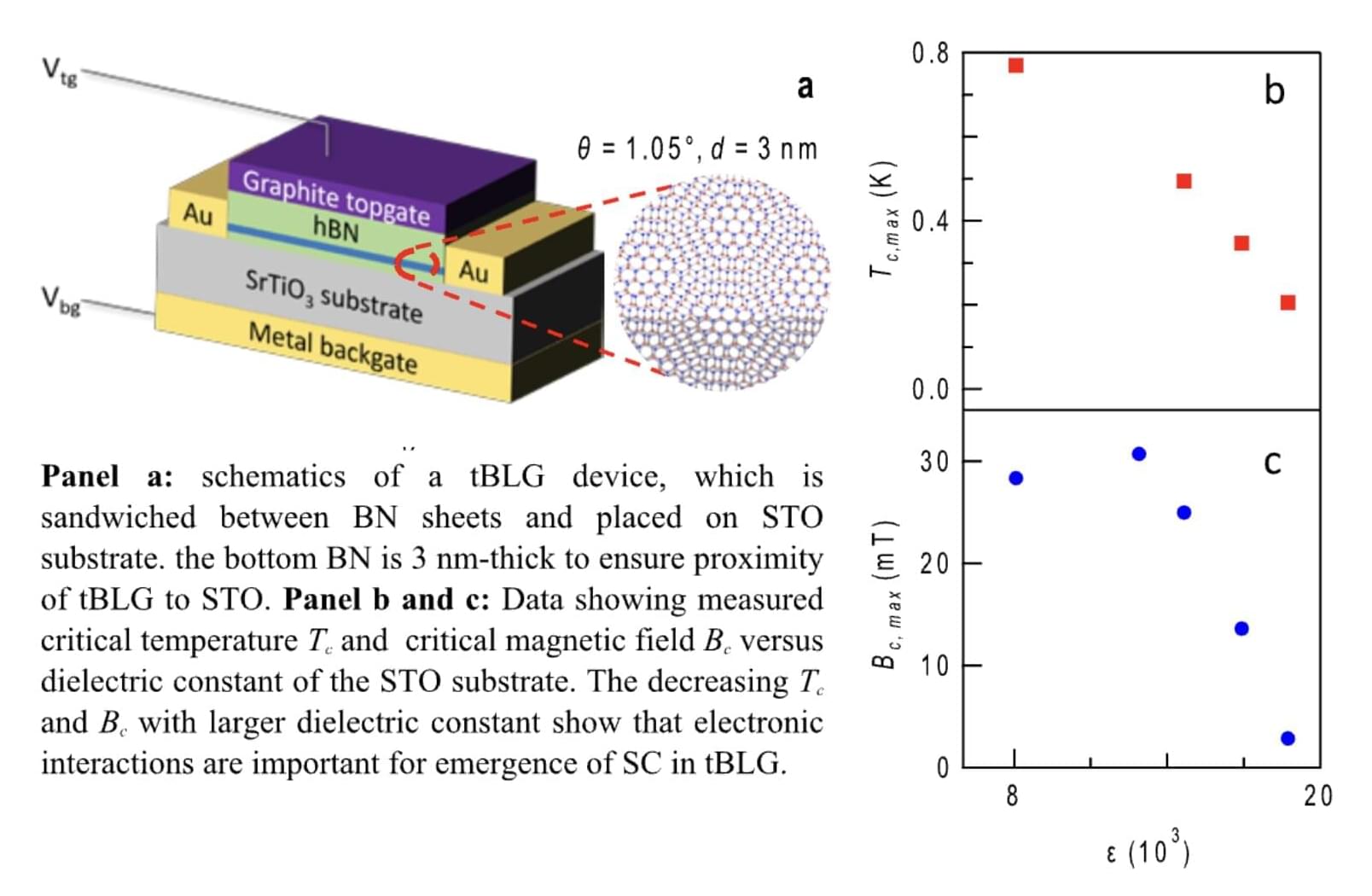
Superconductors are materials that can conduct electricity with a resistance of zero. In so-called conventional superconductors, this occurs at low temperatures when electrons become bound into pairs, known as Cooper pairs.
In some other materials, however, superconductivity (SC) emerges via other electron pairing mechanisms that are still poorly understood. These materials, called unconventional superconductors, include twisted bilayer graphene (tBLG), a two-dimensional material created by stacking two single sheets of graphene on top of each other, one of which is rotated in relation to the other by a precise small angle.
One factor that plays a role in unconventional SC is the so-called dielectric constant. This is the measure of how well a material reduces the electric forces between charged particles.