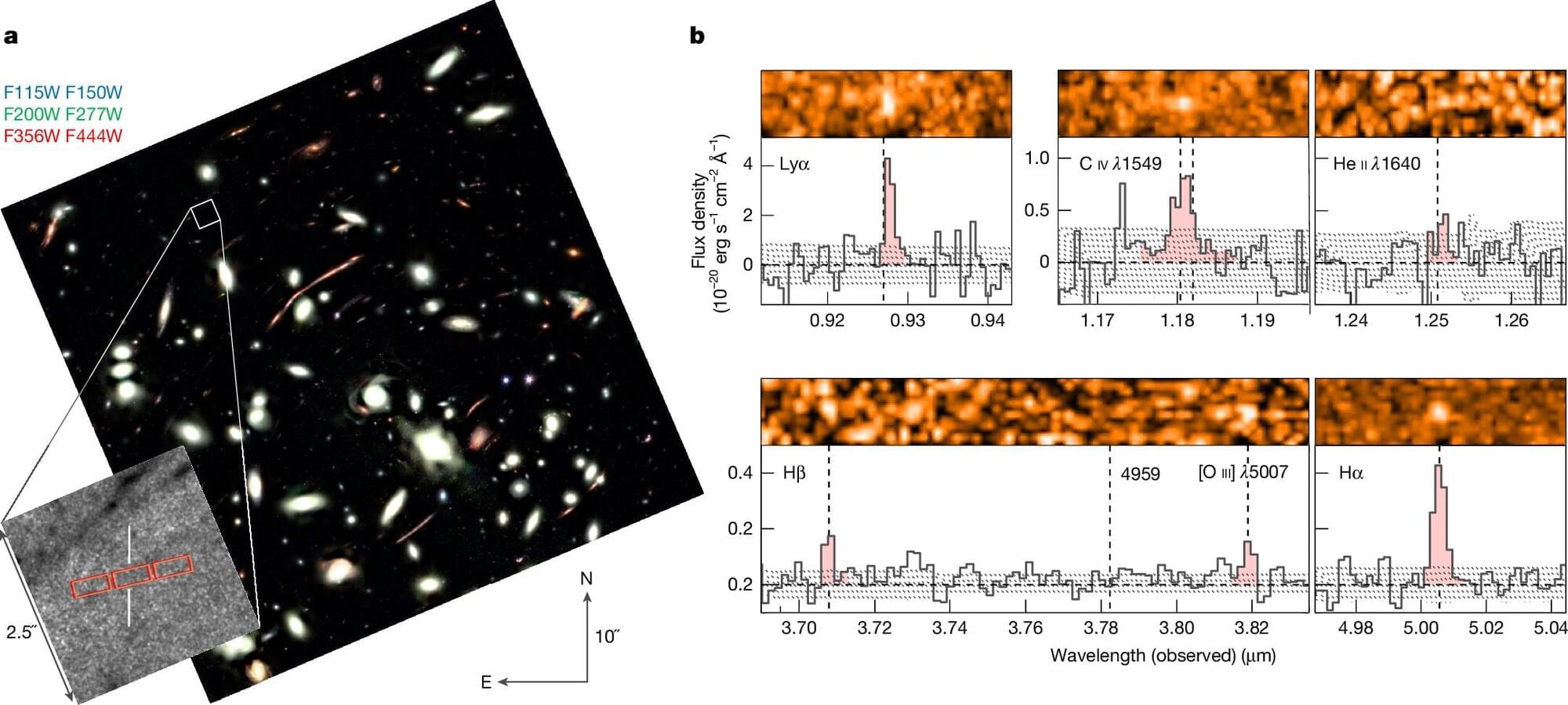
Scientists have discovered a galaxy as it was 13 billion years ago, 800 million years after the Big Bang. It contains possible evidence of the universe’s first stars and is one of the most chemically primitive galaxies observed to date.
The first stars and galaxies are difficult to see because they are so far away and their light is extremely faint. But thanks to the James Webb Space Telescope, we don’t have to remain in the dark about them. This $10 billion observatory was launched in 2021 and can peer back in time to when the first galaxies and stars were forming.
In a paper published in the journal Nature, a team of scientists led by Kimihiko Nakajima, an astronomer at Kanazawa University, Japan, describes how they used the telescope to study a part of the deep universe and discovered a faint galaxy called LAP1-B. “LAP1-B establishes a ‘fossil in the making,’ a direct high-redshift progenitor of the ancient ultra-faint dwarf galaxies observed in the local universe,” they wrote.