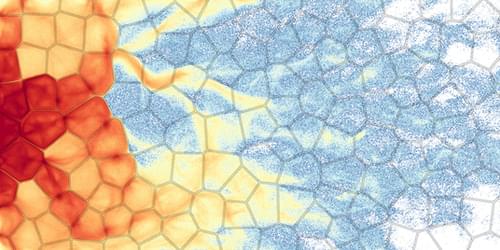
An intense electron beam is stopped more efficiently by a highly porous material than by a less porous material, suggesting new strategies for controlling beams.
New experiments show that porous materials consisting mostly of empty space can absorb the energy carried by an ultraintense electron beam more effectively than porous media with higher mass densities. The finding contradicts the prevailing notion that denser and thicker obstacles always provide more stopping power and suggests that the microstructure of a material fundamentally changes its electron-stopping ability. Simulations by the experimental team revealed the physical mechanisms behind this “anomalous-stopping” effect, which the researchers believe provides a new way to control the propagation of electron beams in extreme environments [1].
The study focuses on relativistic electron beams (REBs), which travel at close to the speed of light. REBs that carry currents in the mega-ampere regime can deliver petawatts (1015 watts) of power to a small target in a pulse lasting for a few picoseconds. This high intensity makes them ideal for creating and probing extreme states of matter that exist in stars, planetary cores, or nuclear events. The short bursts of intense energy provided by REBs are also used in inertial-confinement fusion—a scheme in which high-power lasers heat a fuel pellet and trigger nuclear fusion.