“Up until now, we used a global circulation model (GCM) for Venus that is similar to Earth’s, but this model doesn’t include the hydraulic jump which we have now identified,” said Dr. Takeshi Imamura. [ https://www.labroots.com/trending/space/30535/venus-clouds-d…gest-waves](https://www.labroots.com/trending/space/30535/venus-clouds-d…gest-waves)
What explains the unique behavior of Venus’ clouds? This is what a recent study published in the Journal of Geophysical Research: Planets hopes to address as an international team of scientists led by Japan and included the United States and Spain investigated a longstanding conundrum regarding Venus’ meteorology, specifically cloud weather patterns. This study has the potential to help scientists better understand planetary cloud patterns and what this can teach us about planetary formation and evolution.
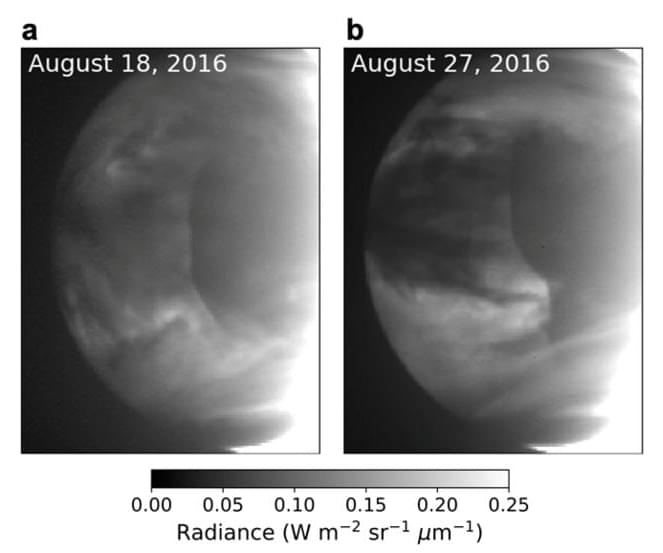
For the study, the researchers used a series of computer models to simulate Venus’ cloud weather patterns, specifically focusing on a 6,000-kilometer-wide (3,728-mile-wide) cloud front whose behavior has puzzled scientists for years. The primary puzzlement is the origin of the massive cloud wave, which current global climate models can’t explain. Along with the puzzlement, the motivation behind the study also comes from a knowledge gap in the formation of the lower cloud regions within Venus’ atmosphere.
In the end, the researchers found that a phenomenon known as a “hydraulic jump” was responsible for producing the massive cloud wave front. This jump is caused by changes in airflow in the lower cloud regions combined with a strong updraft, resulting in sulfuric acid vapor (which comprises Venus’ clouds) to condense, forming the massive cloud wave front. This study helps explain the connection between the Venusian atmosphere motion and clouds.