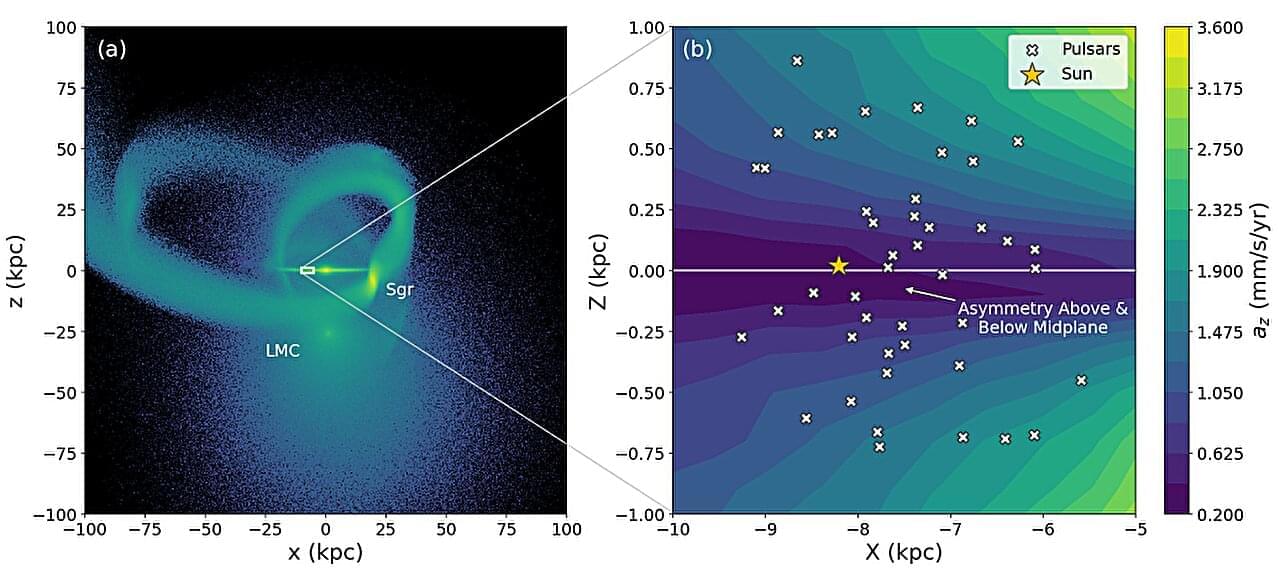
Researchers at The University of Alabama in Huntsville (UAH), a part of The University of Alabama System, have identified a promising new method for measuring the mass of galaxies orbiting the Milky Way by using pulsars, some of the universe’s most precise natural clocks, to detect tiny gravitational effects across our galaxy.
The work, published on the arXiv preprint server, offers a novel approach for studying the hidden dark matter contained within nearby satellite galaxies. The findings could have broad implications for astrophysics and cosmology.
The study was authored by UAH astrophysicists Dr. Thomas Donlon, postdoctoral research assistant II, and Dr. Sukanya Chakrabarti, a professor and Pei-Ling Chan Endowed Chair in the College of Science, in collaboration with Dr. Jason A. S. Hunt, an astrophysicist at the University of Surrey, U.K. The research examines how the gravitational pull of neighboring dwarf galaxies subtly disturbs the Milky Way.