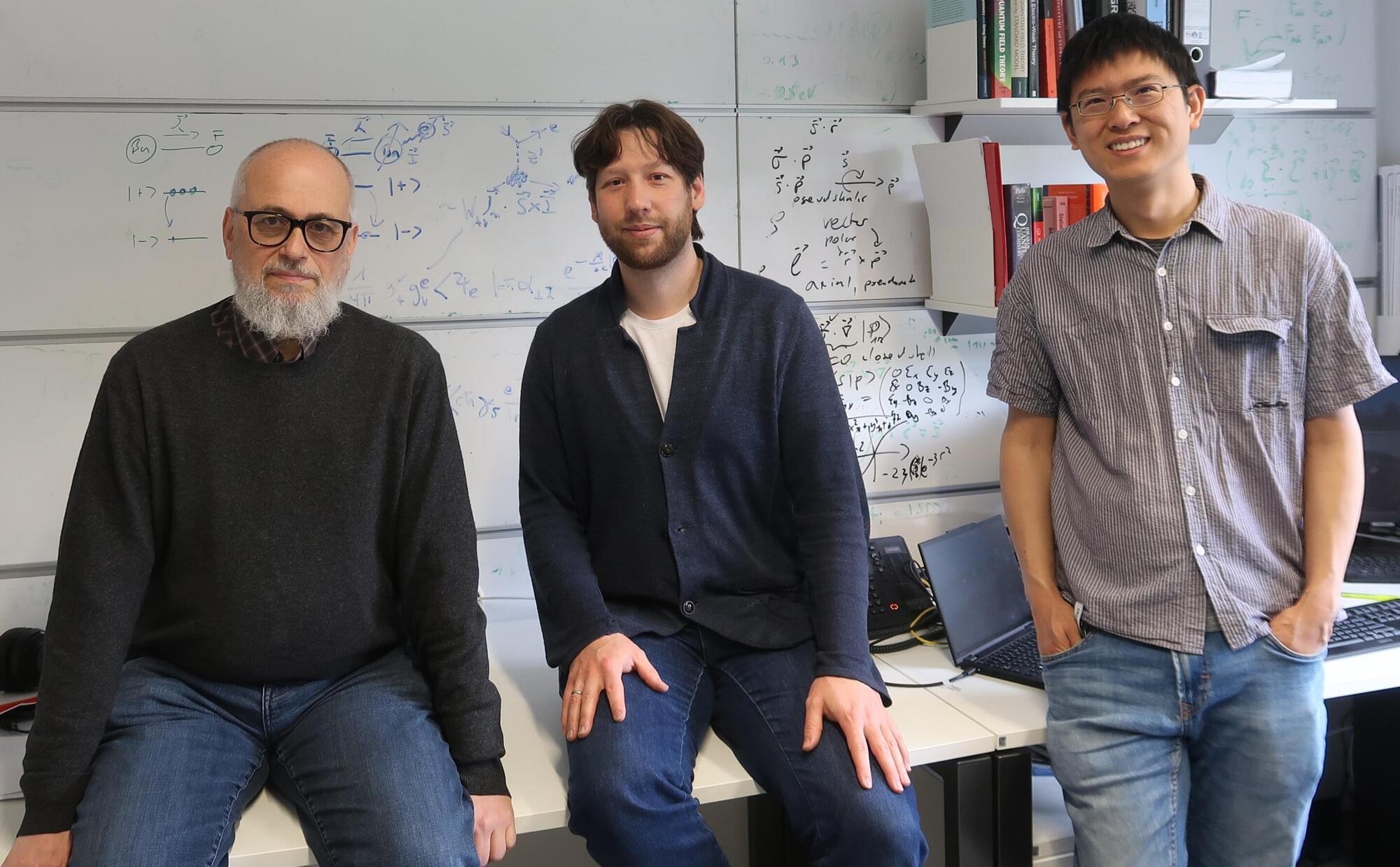
Dark matter particles could be mediators of the interaction between electrons and atomic nuclei, as shown by a study conducted by junior group leader, Dr. Konstantin Gaul, Dr. Lei Cong, and Professor Dr. Dmitry Budker, of Johannes Gutenberg University Mainz (JGU), Helmholtz Institute Mainz (HIM) and the PRISMA++ Cluster of Excellence. Their work, published last week in Physical Review Letters, presents new constraints on previously unexplored candidates for dark matter and, more generally, some hypothetical particles that are not included in the Standard Model of particle physics ℠.
Using results from precision measurements on barium monofluoride (BaF) molecules, the team constrained these interactions mediated by Z’ bosons for the first time. Z’ bosons are hypothetical mediators of the weak interaction and possible dark matter particles in several SM extensions. “These results address a significant blind spot in physics: a regime of forces between electrons and nuclei that had remained unexplored by both laboratory experiments and cosmological data,” explained Gaul.
Our universe is made up of about 4% of visible, or ordinary, matter. This includes planets, stars, and life on Earth. The remaining 96% of the universe is invisible and consists of dark matter and dark energy, with dark matter making up about 23%. Astrophysical observations confirm its presence throughout the cosmos, where it, for example, plays an important part in the structure of galaxies. However, we don’t know what particles make up dark matter. Many theories and ongoing experiments are looking for an answer to this open question.