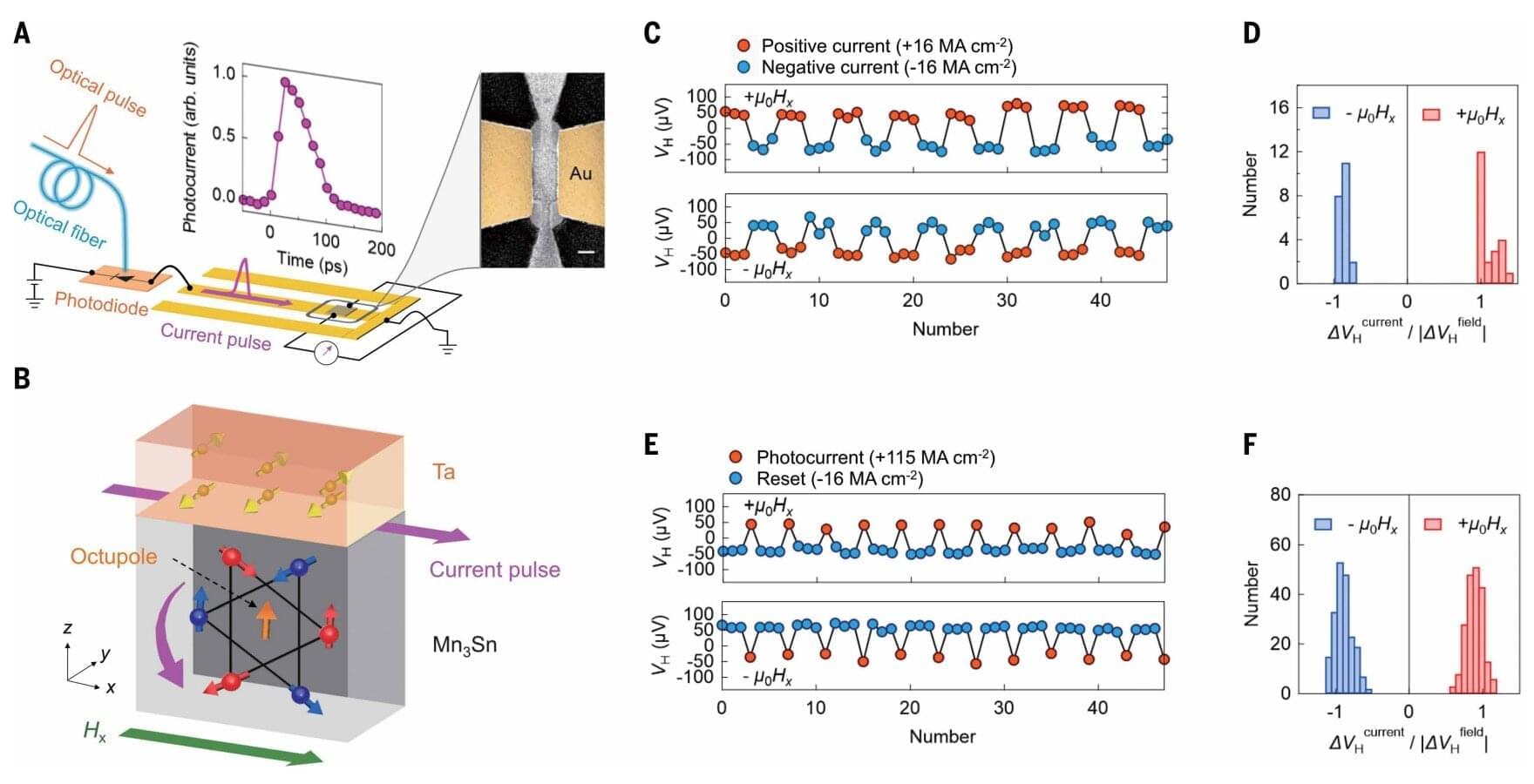
Modern energy demands are soaring as technologies like AI and IoT become more common, and researchers have been working hard to develop hardware that can keep up. Now, a team of researchers from the University of Tokyo has developed an ultrafast and energy-efficient nonvolatile switching device, described in an article published in the journal Science, that may soon be able to significantly reduce power consumption for high-energy demand technologies.
Currently, most nonvolatile switching devices for data processing architectures have operating speeds in the nanosecond range. However, faster speeds are required for modern central processing units (CPUs), which operate in the gigahertz range.
At 5 GHz, a single cycle lasts only 200 picoseconds. If a switching device takes a nanosecond (1,000 picoseconds) to turn on or off, it misses multiple clock cycles, creating a major bottleneck that prevents the processor from operating continuously at full capacity. Optical interconnects are being explored to overcome electronic bottlenecks, but more efficient optical-to-electrical (O/E) conversion is still needed.