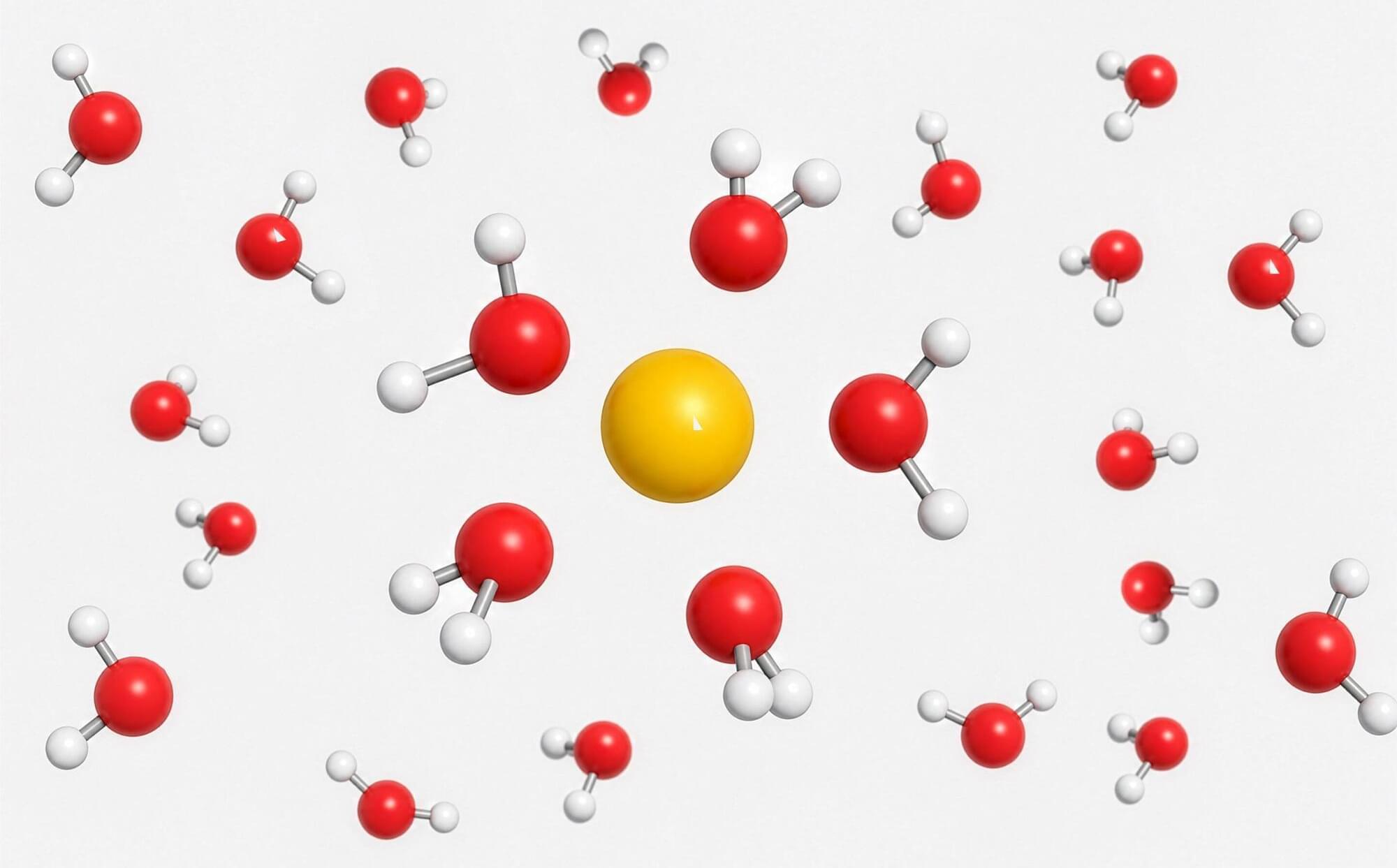
Water molecules do not simply swirl around in complete disorder; they can form certain preferred structures. This scientific fact is often presented in entirely unscientific ways. For example, when people speak of an alleged “memory of water” or of “water clusters” as a possible explanation for homeopathy, among other things.
All of this has been refuted. But even though water is not a magical information storage medium, its ability to form short-lived structures can have important consequences. This has now been shown in a study by TU Wien, in collaboration with the University of Vienna and the University of Oslo, as part of the Cluster of Excellence “MECS.” The team investigated how easily charged particles can be held at a surface—a question that is important in many areas, such as research on batteries, fuel cells, and biological membranes. The new results show that this can only be understood if one takes into account the structures that water forms on nanosecond timescales.
The research is published in the journal Science Advances.