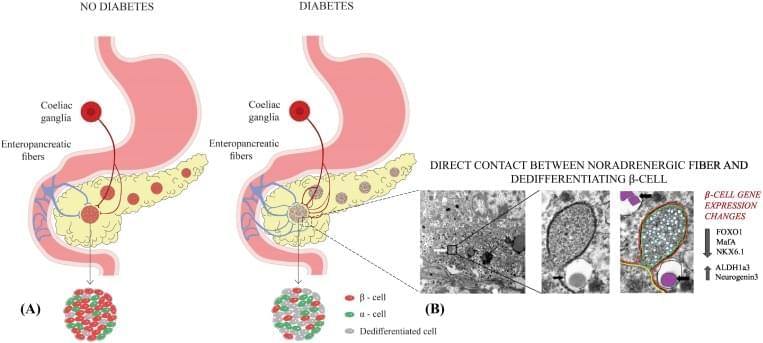
Noradrenergic innervation and β-cell dedifferentiation in diabetes.
Dedifferentiation, a survival mechanism whereby mature β-cells revert to a nonfunctional state under metabolic stress, represents a fundamental driver of β-cell failure in type 2 diabetes.
Dedifferentiation is reversible, primarily through dietary intervention or bariatric surgery, and redifferentiation may promote type 2 diabetes remission.
Noradrenergic fiber density is increased in diabetic pancreases and correlates with β-cell dedifferentiation, suggesting that altered signaling may trigger the process.
A link between diet, redifferentiation, reduction of noradrenergic fibers, and type 2 diabetes remission has been hypothesized.
The review proposes that targeting pancreatic noradrenergic innervation could be a novel therapeutic strategy to reverse β-cell dedifferentiation, restore insulin function, and achieve type 2 diabetes remission. sciencenewshighlights ScienceMission https://sciencemission.com/noradrenergic-innervation–in-diabetes
β-Cell dedifferentiation is a key mechanism of β-cell failure in type 2 diabetes (T2D). To survive metabolic stress, β-cells adopt a progenitor-like state, allowing for potential redifferentiation and T2D remission when conditions improve. Glucolipotoxicity is a known driver of β-cell failure, but the triggers of dedifferentiation remain unclear. Recent research has focused on pancreatic islet innervation, particularly the role of noradrenergic fibers in inhibiting insulin secretion. An increase in noradrenergic fibers has been correlated with β-cell dedifferentiation in humans, suggesting a role in T2D pathogenesis. This review explores the link between β-cell dedifferentiation and pancreatic noradrenergic innervation across murine and human models and examines the possibility of targeting innervation to reverse dedifferentiation, restore insulin secretion, and achieve T2D remission.