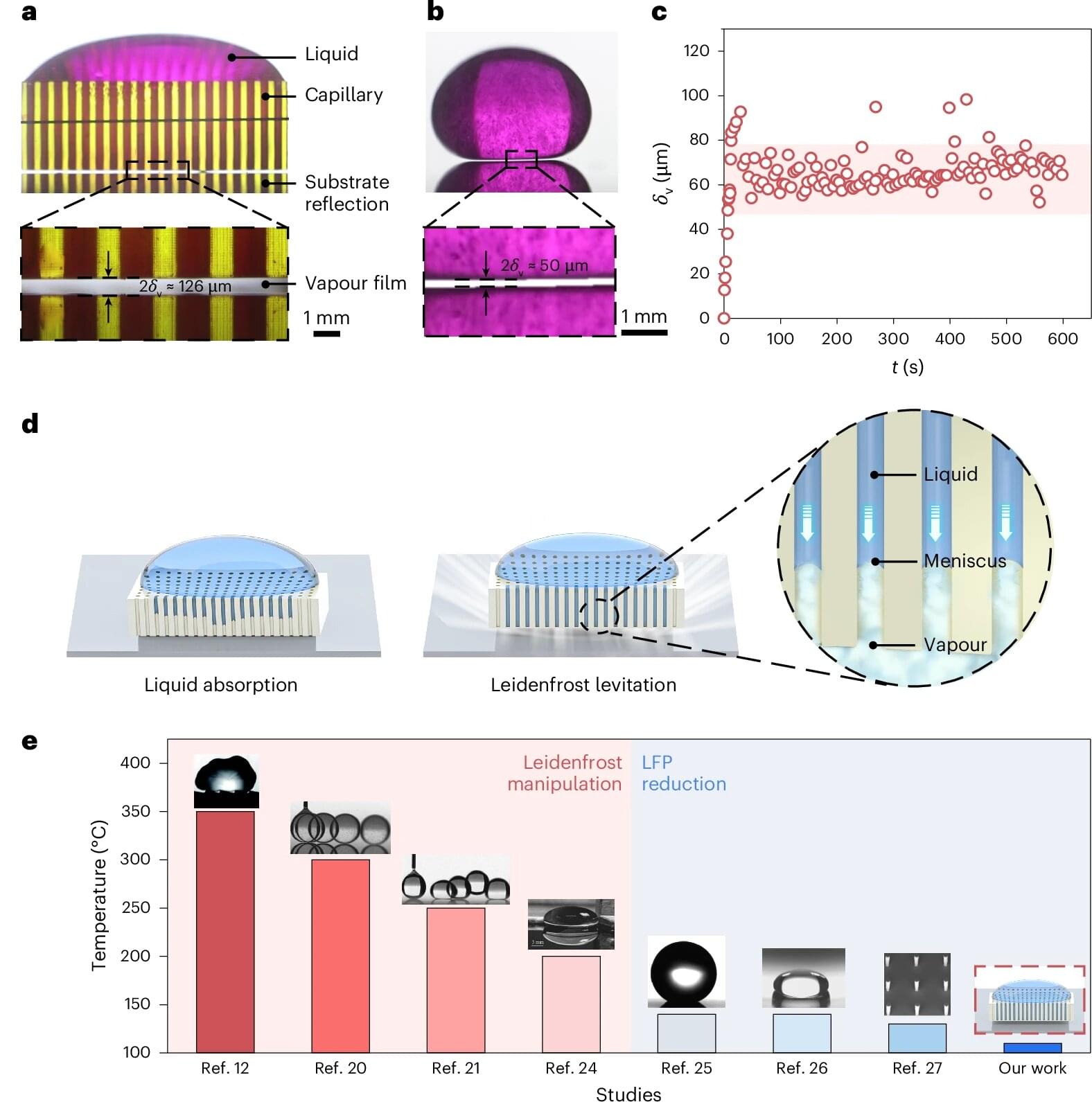
A research team led by Professor Steven Wang, Associate Vice President (Resources Planning) and Associate Professor in the Department of Mechanical Engineering and School of Energy and Environment, has designed a revolutionary capillary structure that can trigger the Leidenfrost effect, offering a practical solution for the temperature-regulated Leidenfrost effect without requiring complex surface engineering.
The study, titled “Capillary Leidenfrost Effect”, was recently published in the journal Nature Physics.
The Leidenfrost effect is a physical phenomenon discovered in 1756. It occurs when a liquid droplet touches a surface much hotter than its boiling point, forming a vapor layer that makes it levitate and hover, slowing down evaporation. A simple example is water on a very hot pan: the drops sizzle and disappear quickly, but once it reaches the Leidenfrost point, they bead up, skate and dance around on a steam barrier, and last much longer before evaporating. This effect is ubiquitous in a wide range of laboratory and industrial applications.