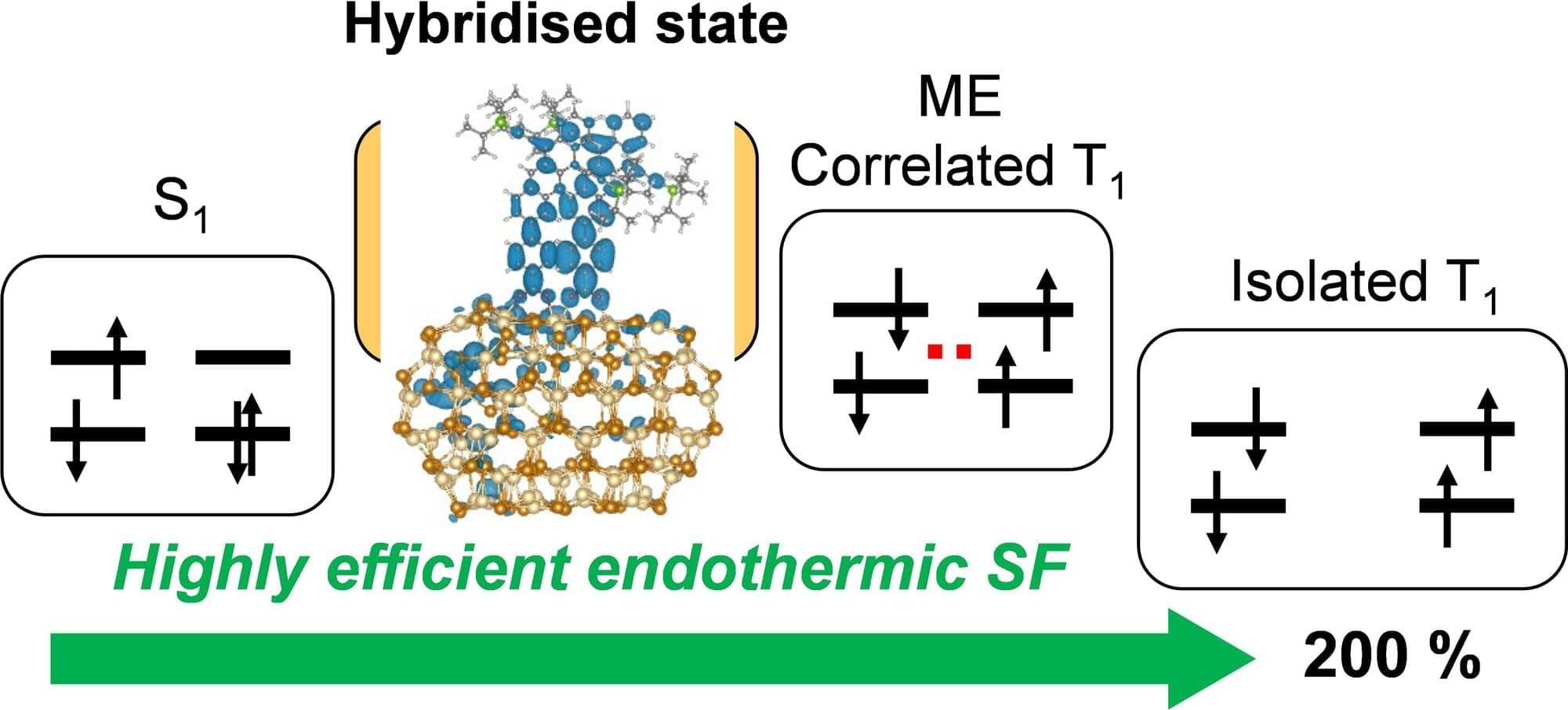
Solar panels have become more efficient over the years, but even the best designs still lose a large fraction of the energy they absorb. Scientists around the world have been searching for ways to capture more energy from every ray of sunlight and unlock the true potential of solar technology.
In a study published in Nature Photonics, researchers from the University of Osaka and collaborating institutions identified a new mechanism that could help us do exactly that. The study shows how specially designed combinations of molecules and quantum dots can be used to dramatically increase solar cell efficiency beyond currently known limits.
Singlet exciton fission is a photophysical phenomenon in which one particle of light creates two excited energy states instead of one. In theory, this allows solar cells to generate more electricity from the same amount of sunlight. However, the most effective photophysical processes require extra energy and are usually inefficient and difficult to control.