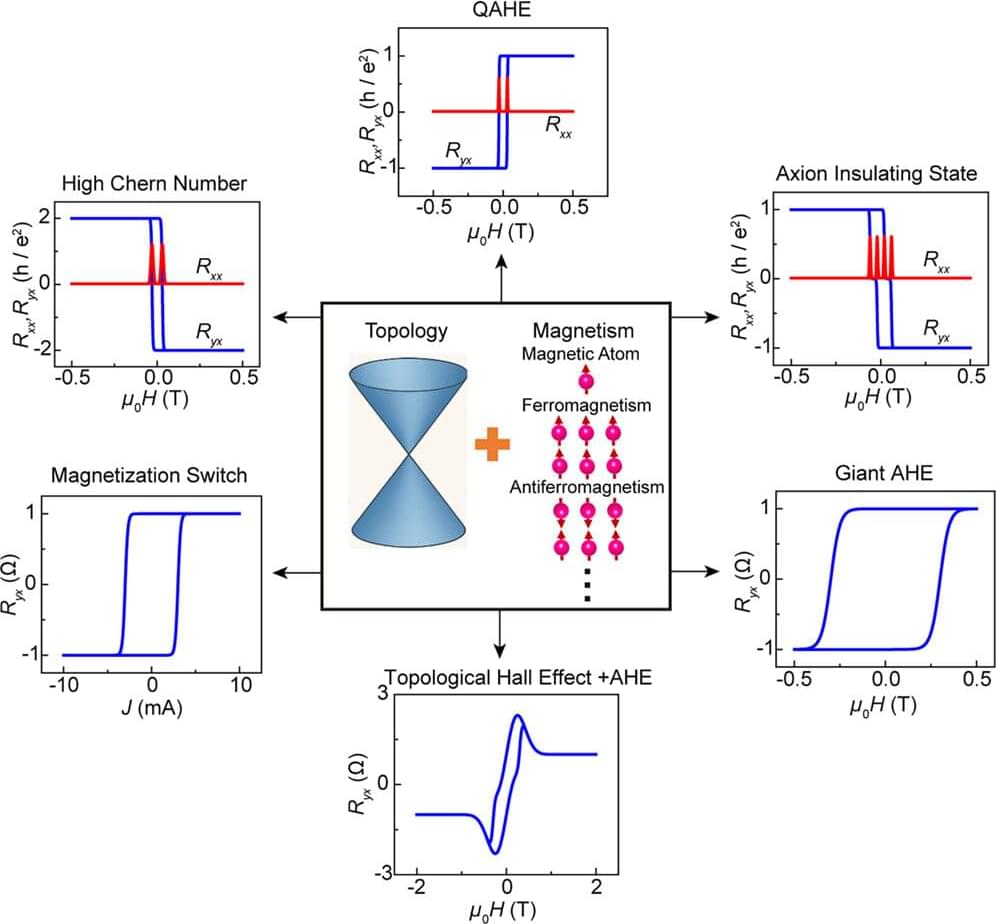
Imagine a laptop that never gets hot, a phone that holds its charge for days, or a computer memory chip designed to permanently retain data, even when the power goes out. This is the possibility sitting inside a remarkable family of materials that a team of researchers from the University of Ottawa and the Massachusetts Institute of Technology (MIT) has spent years trying to understand, and they just published a comprehensive roadmap of the field to date in the journal Newton.
Magnetic topological materials sit at the crossroads of magnetism and topology in modern physics. Topology is the mathematical study of shapes that cannot be continuously deformed into one another. In these materials, that idea protects the flow of electrons in a way that normal materials simply cannot.
“Magnetic topological materials offer a unique platform where magnetism and quantum physics work together in ways we are only beginning to fully understand,” explains Hang Chi, Canada Research Chair in Quantum Electronic Devices and Circuits and Assistant Professor at uOttawa’s Department of Physics. “This review brings together the field’s most significant advances and gives researchers a shared foundation to build on.”