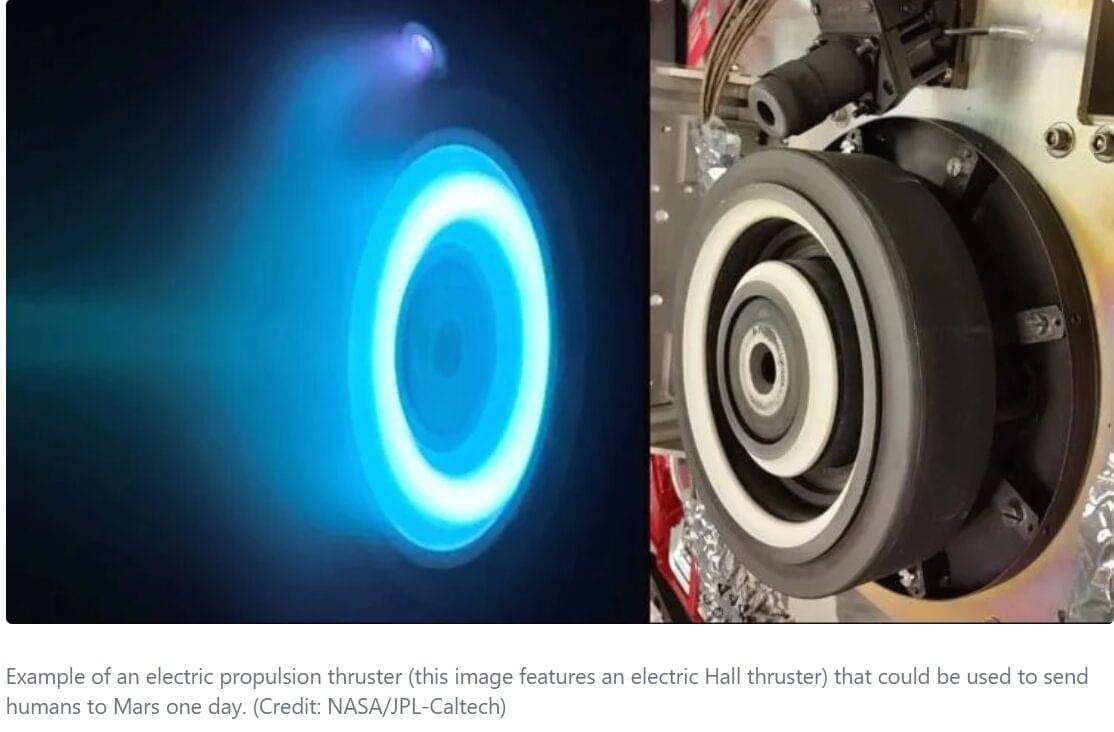
You’re on the fourth human mission to Mars, and you’re told the Odyssey spacecraft designed to take you there will be the smoothest ride you’ll ever take. It features a newly christened electric propulsion engine which was in the late stages of testing during the first three missions. The mission starts and the spacecraft travels at a crawl, and you wonder if it’s broken. A week goes by and you’re now traveling at more than 400,000 kilometers (250,000 miles) per hour, and your mind is blown as to how fast you’re going, how quickly that happened, and that this mission might be more awesome than you thought.
This scenario is quite possibly a decade away, at minimum, but that’s not stopping the bright minds at NASA from building and testing next-generation propulsion systems designed to take humans to Mars one day and send spacecraft across the solar system. This is because NASA engineers recently tested a next-generation electric propulsion system that achieved new records while requiring lithium metal vapor for fuel and holds the potential to be a game changer in propulsion systems for the future of space exploration.
In a remarkable achievement, the tests successfully set a new record in the United States of 120 kilowatts of power, which is estimated to be 25 times greater than NASA’s Psyche spacecraft, which is currently en route to asteroid 16 Psyche and contains the most powerful electric thrusters ever built.