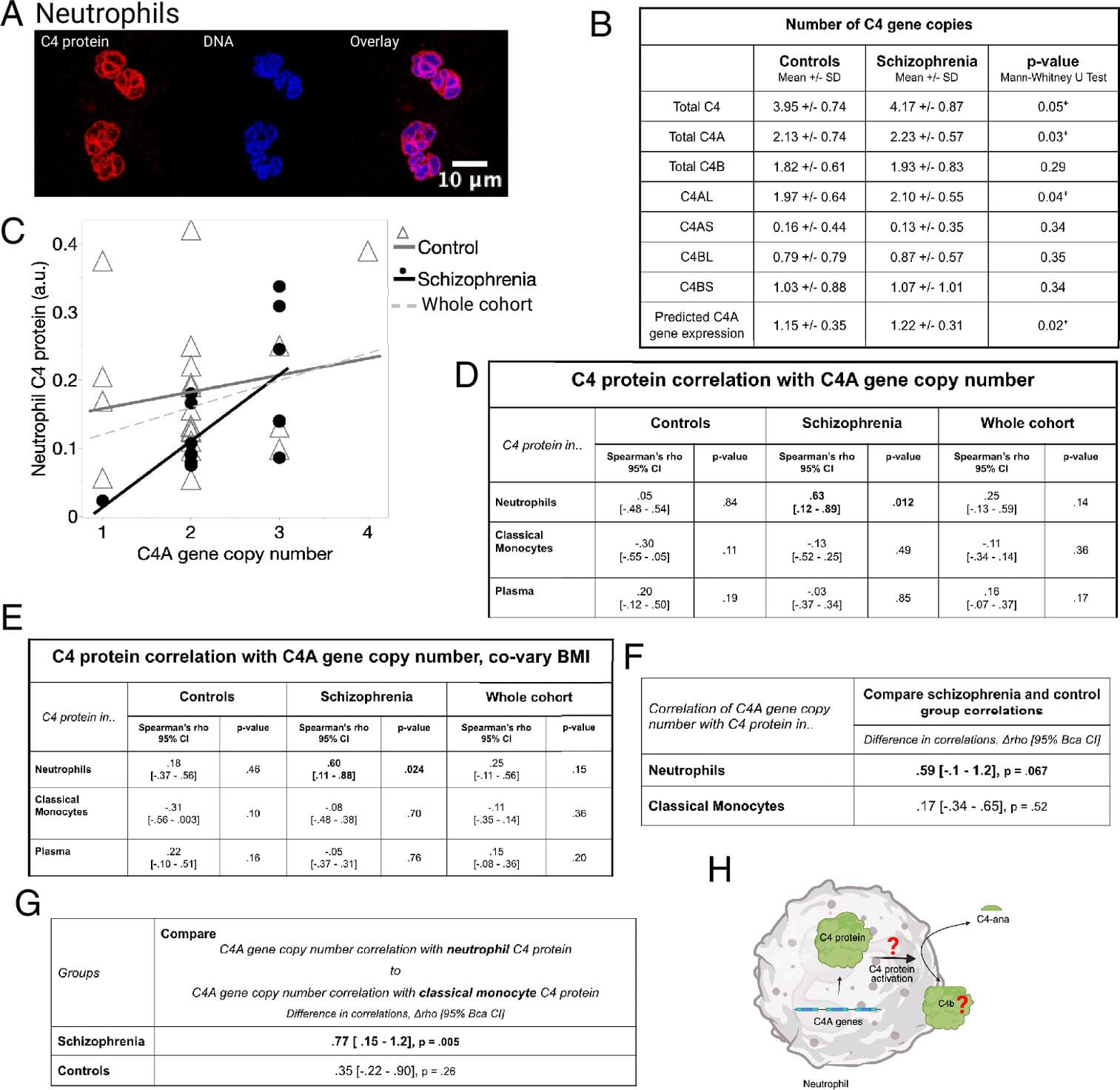
The most common white blood cells in your body—immune cells called neutrophils—can make a protein nobody knew they were making, Stanford Medicine investigators have discovered. That unexpected sighting joins a growing list of hints tying schizophrenia, a disorder of the brain, to events occurring elsewhere in our bodies. The findings are summarized in a paper published in Proceedings of the National Academy of Science.
The newly noticed neutrophil nexus, as a source of the protein called C4A, links a long list of other observations that are somewhat puzzling when looked at in isolation: For example, large-scale population-genetic studies have identified C4A, already known to be produced mainly in the liver, as a pronounced risk factor in schizophrenia. People with schizophrenia tend to have increased numbers of neutrophils in their blood. And the most effective medication for schizophrenia inhibits neutrophils.
Schizophrenia affects one in every 100 persons globally almost without variation by geography or ethnicity. Its most noticeable symptoms are hallucinations, delusions and fixations. A fundamental feature of the disease is cognitive impairment: inability to think clearly, reduced working memory, disorganized thinking and behavior.