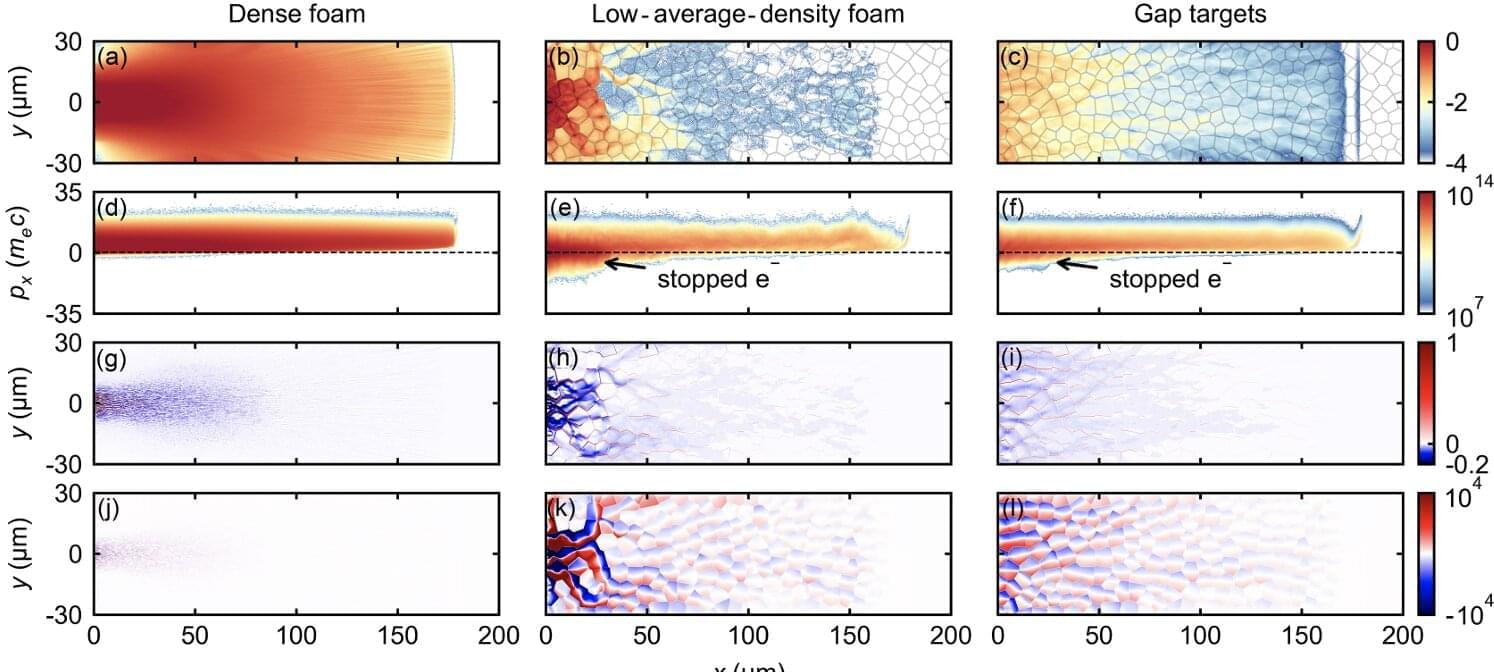
When physicists fire beams of fast electrons at materials, they often need to know exactly how much energy those electrons will lose as they travel through. Through new research published in Physical Review Letters, a team led by Ke Jiang at Shenzhen Technology University in China has found that porous, mostly empty foam materials can stop high-current electron beams far more effectively than denser materials—overturning many previous assumptions about how these beams interact with solid materials.
When a beam of electrons travels through a solid, its energy is lost through collisions with the atoms and electrons already present in the material. But when electron beams carry extremely intense currents, driving electrons to travel close to the speed of light, individual collisions are no longer the dominant factor.
Instead, the beam generates powerful electromagnetic fields as it moves, which shape how the beam propagates and loses energy. In fields ranging from nuclear fusion to studies of planetary interiors, it is often crucial for physicists to manage this energy loss as tightly as possible.