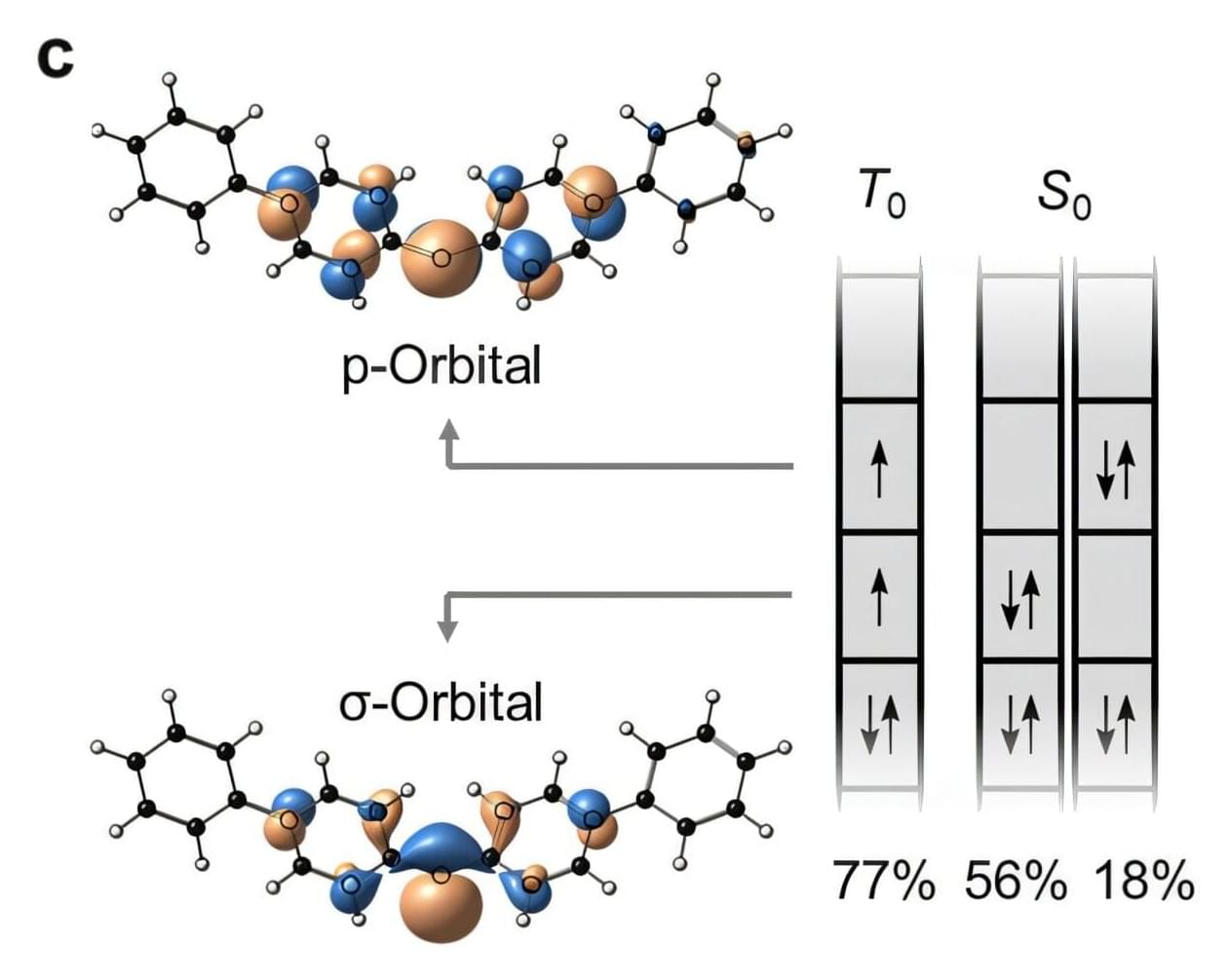
Within a crystal’s atomic structure, tiny atomic-scale flaws will naturally occur where electrons can become trapped. These defects have emerged as one of the leading platforms for quantum information processing. Through a new study, posted to the preprint server arXiv, Ilai Schwartz and colleagues at NVision Imaging Technologies in Germany have shown that a specialized molecule embedded inside a crystal could take this approach a step further, offering a more controllable and versatile route to building quantum systems.
Unlike the classical computers we use every day, quantum computers encode information in the quantum states of qubits, which can exist in combinations of 0 and 1 simultaneously. This quantum information can’t simply be copied or transmitted in the same way as classical bits: when a qubit is measured, its quantum state is disturbed, making it impossible to transmit its information directly.
To tackle this problem, qubits must be connected to photons, which can transmit their quantum information between distant parts of a network. This connection relies on what physicists call a “spin-photon interface”: a structure in which the quantum state of an electron or nucleus can be reliably written, read, and communicated via light.