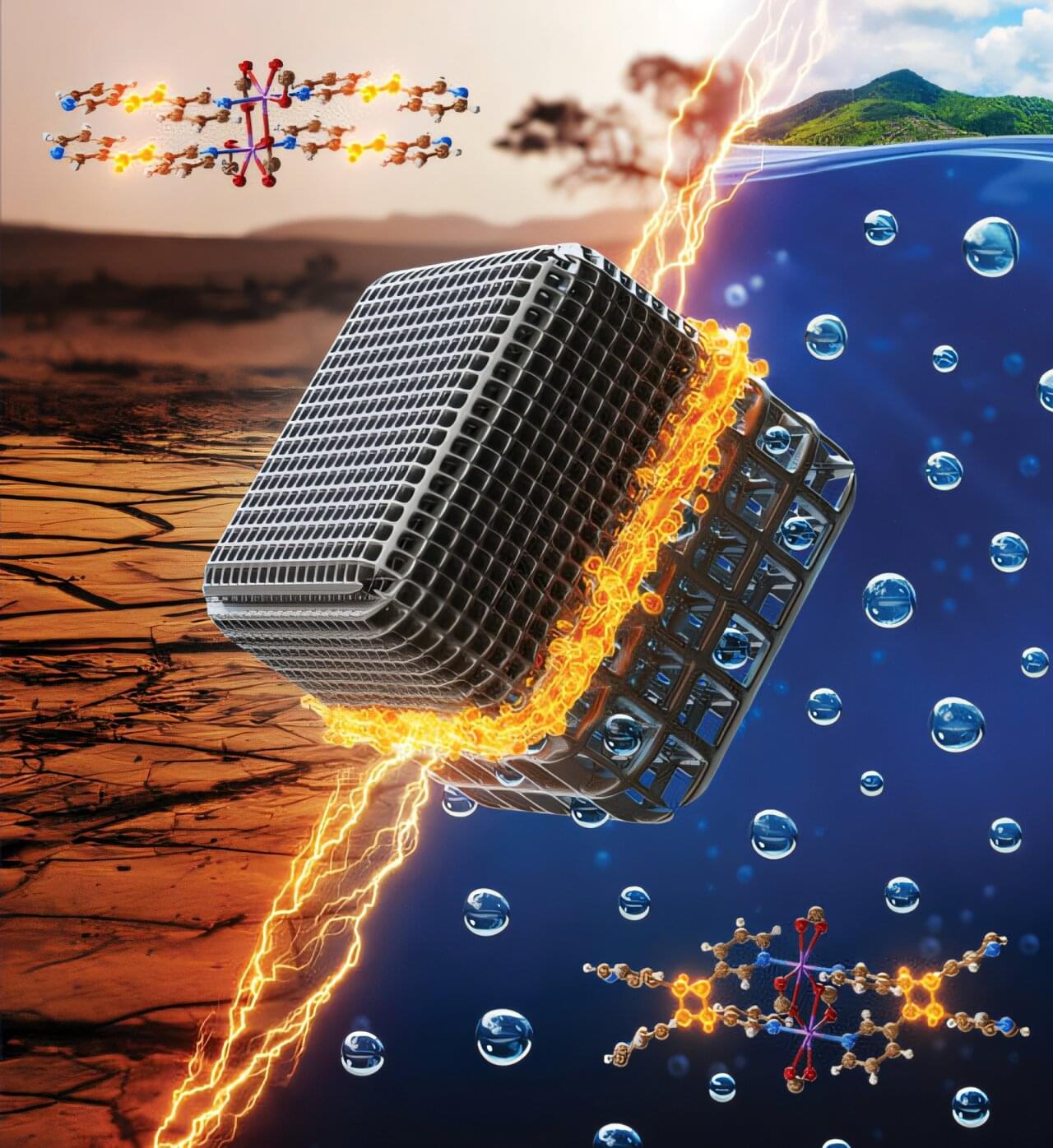
Chemists at the University of Iowa have created a three-dimensional lattice that captures water from the air and stores it. In a new study appearing in the Journal of the American Chemical Society, researchers describe a millimeter-scale structure made of metal atoms connected by two types of organic molecules. When exposed to ultraviolet light, the material undergoes a chemical reaction that changes its shape, creating cavities throughout the lattice. Those cavities attract water molecules from the air and store them—like a multitude of tiny canteens.
The results, which would need to be tested at larger scales, show promise as a method to help provide drinking water to people and areas with limited access. Water stress or scarcity will affect nearly five billion people—half the world’s projected population—by 2050, according to the United Nations.
“We have found and validated a way to capture and to store water that would require only sunlight,” says Leonard MacGillivray, adjunct professor in the Department of Chemistry and former professor and department chair. “You can transport the crystal lattice and eventually release the water on demand. That’s why it’s such an advance.”