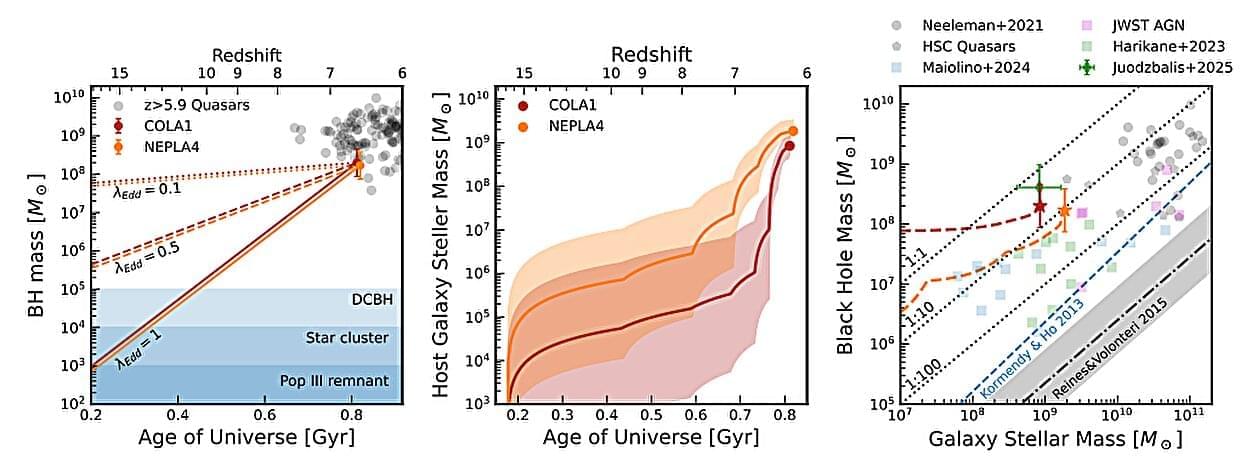
Astronomers have discovered two early-universe galaxies where the central black holes appear to have grown far faster than their host galaxies. Observations with the James Webb Space Telescope (JWST) reveal that the black holes in these galaxies, seen just 800 million years after the Big Bang, are significantly more massive relative to their host galaxies, as opposed to what astronomers see in the nearby universe. The study is published on the arXiv preprint server.
Astronomers have long discovered quasars—extraordinarily luminous galaxies powered by accreting black holes weighing billions of solar masses—in the first billion years of the universe. For these to exist so early, the black holes must have started as large as heavy seeds and grown at their maximum rate possible for most of their lives. These early black holes appear oversized compared to the galaxies they live in.
On the other hand, when JWST began its operation in 2022, it made a huge splash in astronomy with the discovery of an astonishingly large number of mature galaxies and black holes in the first billion years of the universe. Among them were some “overmassive” black holes weighing billions of times the mass of our sun, but rarely as massive as those found in luminous quasars.