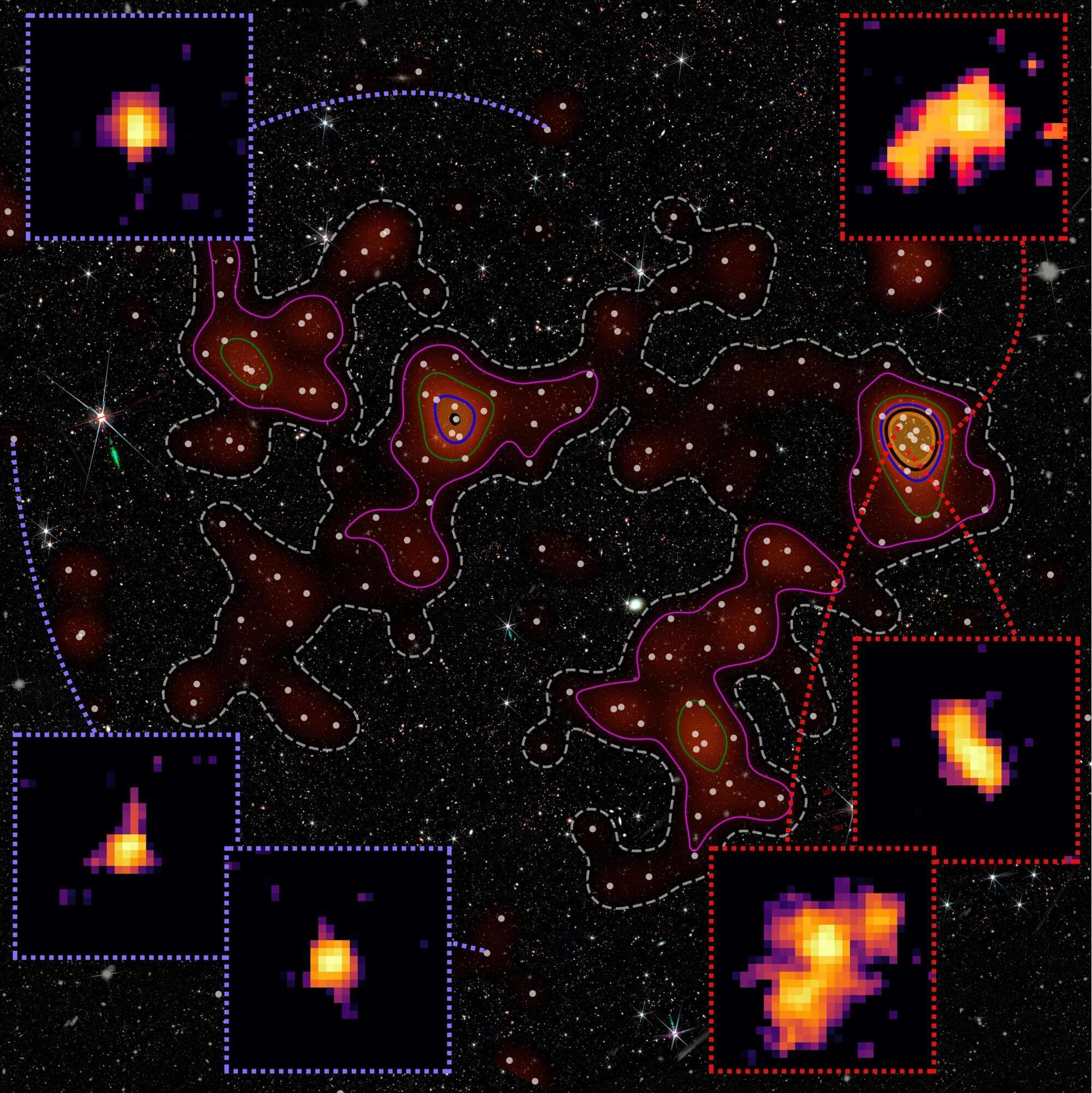
A large protocluster of galaxies that existed 12.6 billion years ago, first discovered with the Subaru Telescope, has been examined in detail using the James Webb Space Telescope (JWST). The study found that galaxies in crowded regions are more extended than similar galaxies in less dense environments. The results, published in The Astrophysical Journal Letters, show that even when the universe was only 1.2 billion years old, environment was already influencing how galaxies grow.
In today’s universe, galaxies are not spread evenly through space. They have gathered into groups, and those groups form enormous galaxy clusters containing hundreds or even thousands of galaxies. But these giant structures did not exist at the beginning of the universe.
In the early universe, slightly denser regions of matter gradually grew under gravity and eventually developed into galaxy clusters. These “seeds” of galaxy clusters are known as protoclusters.