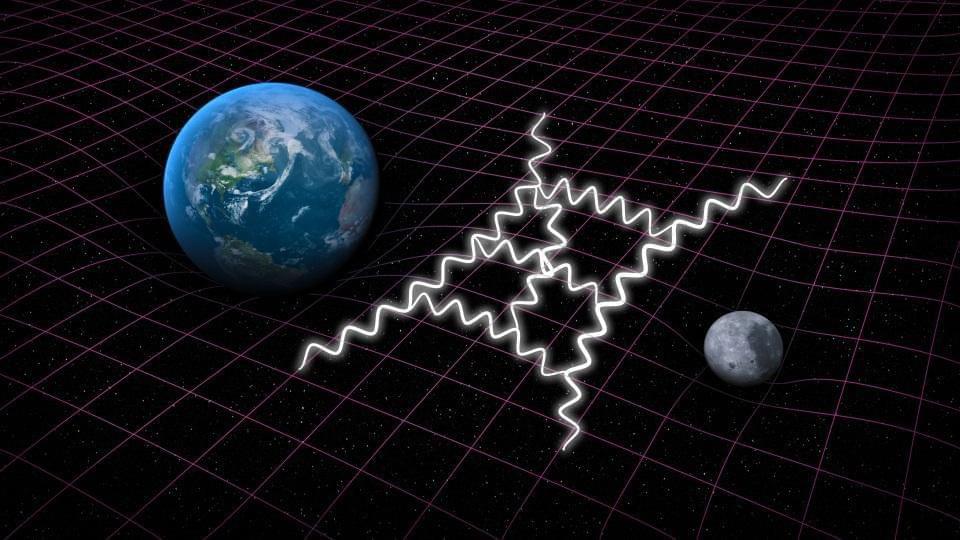
So why not do the same thing for a gravitational field? Well, it turns out that quantum renormalization only works for Euclidean space. In general relativity, the mass-energy of a system warps space and time. So all those quantum fluctuations curve spacetime, and curved spacetime induces even more virtual particles, which warp space even more… oh no! It all breaks down, and we can’t quantize gravitational fields the way we quantize the other fundamental forces.
Problems like these have led some researchers to develop a model known as loop quantum gravity. Rather than trying to calculate the behavior of quantum particles in a timey-wimey background, why not treat the entire mass-energy-spacetime structure as a single quantum system? It’s like imagining the Universe within an unseen background that is Euclidean. This way the problem of renormalization can be overcome in many cases. One case where it doesn’t work well is the cosmological constant. In most cosmological models, the cosmological constant is what drives cosmic expansion. Since it is a universal dark energy field, it amplifies the loop quantum gravity sums, and once again the whole thing diverges. You can handle this by fixing the cosmological constant to a specific value, but that isn’t really a solution to the problem. It’s the cosmology equivalent of ignoring the engine light in your car…
A new study finds this might not be too bad after all. In it, the authors demonstrate an interesting similarity between the cosmological constant in loop quantum gravity and the quantum Hall effect in standard quantum theory.