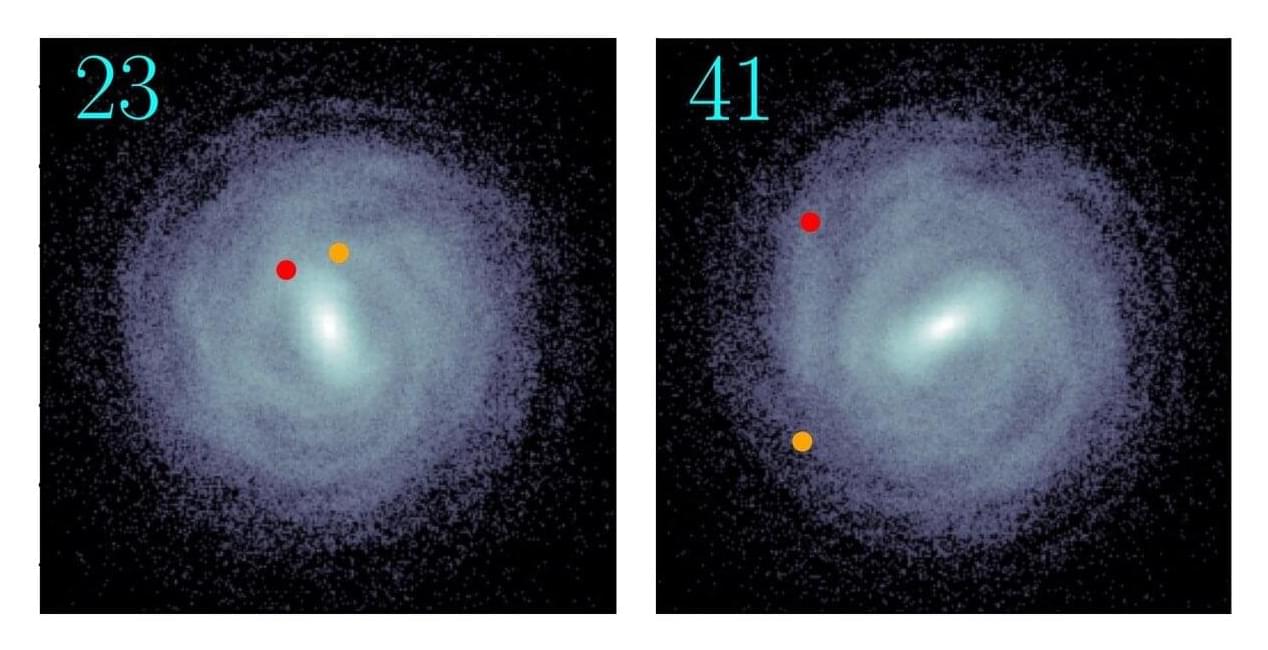
Astronomers who simulate galaxies do not always get the same result, even when they start from identical conditions. New research from Leiden University shows that this is not a flaw, but a consequence of how galaxies behave—and how they are modeled.
The findings offer, for the first time, a way to address a long-standing question: how chaotic is a galaxy like the Milky Way really? The computer simulations by Tetsuro Asano and Simon Portegies Zwart (Leiden Observatory) will soon be published in Astronomy & Astrophysics and are available now on the arXiv preprint server.
The researchers created hundreds of models of Milky Way-like galaxies: flat disks of stars, embedded in a large, invisible cloud of dark matter that holds the system together. In each experiment, they ran two almost identical simulations, differing by just one tiny detail—for instance, a small shift in the position of a single star. Over time, that slight difference grows into visible structural changes: the spiral arms develop differently and the central bar rotates in another way.