For the past tens of thousands of years, our Solar System has been traversing the local interstellar cloud (LIC), one of the 15 clouds of gas and dust that occupy the Sun’s neighborhood. Dust that might have come from the LIC has been found on Earth’s surface, its interstellar origins earmarked by an iron isotope produced in supernovae (see Synopsis: Seeking Stardust in the Snow). Now more traces of iron-60 (60 Fe) have turned up, this time buried in ancient Antarctic ice [1]. Dominik Koll of the Helmholtz-Zentrum Dresden-Rossendorf in Germany led the team that purified and analyzed the ice. He and his colleagues inferred that the LIC is the likeliest source of the 60 Fe and that the LIC is the result of past supernova activity.
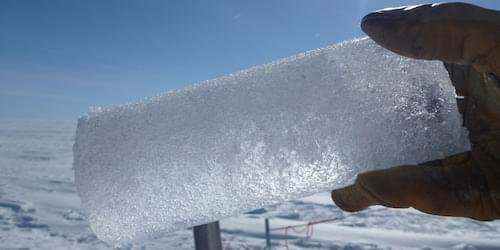
Gas and dust trapped in the layers of Earth’s ice sheets provide a record of past environments. Koll and colleagues took 300 kg of an Antarctic ice core, representing the period 40–80 thousand years ago. They melted the ice, extracted the radionuclides, and used mass spectrometers to identify 60 Fe along with manganese-53. The latter is produced with 60 Fe when cosmic rays strike interplanetary dust. Because the researchers found more 60 Fe than expected from this “local” source, they concluded that the surplus came from beyond the Solar System.
Combining measurements from contemporary Antarctic snow and recent deep-sea sediments, Koll’s team reconstructed the influx of 60 Fe to Earth over the past 80 thousand years. The measured profile showed a very low 60 Fe influx around the time the Solar System entered the LIC, a peak while traversing the cloud, and a gradual decline as it nears the exit. The most direct explanation for the pattern is that the LIC is part of a single supernova remnant, but other explanations are in play.