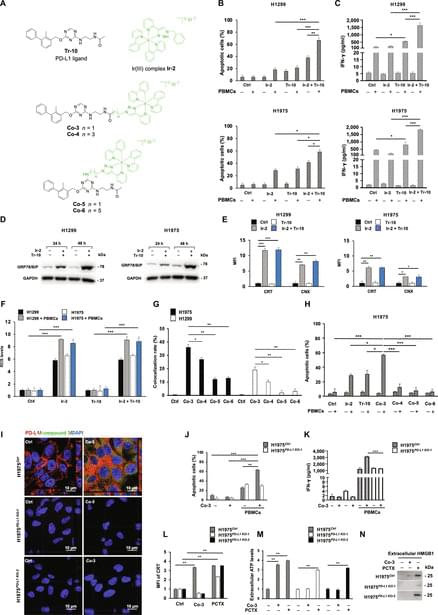
Immunotherapy targeting programmed cell death protein 1 (PD-1) and programmed death ligand 1 (PD-L1) has transformed the management of several types of cancers, including non-oncogene-addicted non-small cell lung cancer (NSCLC) [1], although its efficacy remains limited by resistance mechanisms and constraints inherent to monoclonal antibodies [1]. To overcome these drawbacks, small-molecule PD-L1 inhibitors have been developed, and we previously contributed by identifying the nanomolar triazine-based ligand Tr-10 [2]. In parallel, combinatorial strategies aimed at improving the efficacy of anti-PD-1/PD-L1 immunotherapy have gained increasing attention. Notably, platinum-based chemotherapy combined with immune checkpoint inhibitors is recommended as a first-line treatment for advanced NSCLC with PD-L1 expression <50% [3]. Here, we investigated a novel combination involving our anti-PD-L1, Tr-10 [2], and a bis(phenyl-pyridine)iridium(III) complex, Ir-2 (Fig. 1A) [4]. Iridium (Ir) complexes, unlike platinum drugs, are chemically inert and induce endoplasmic reticulum (ER) stress and overproduction of reactive oxygen species (ROS) [5,6], both culminating in damage-associated molecular pattern (DAMP) release and immunogenic cell death (ICD). Moreover, their photophysical properties enable PD-L1-targeted bioimaging when coupled with PD-L1 ligands (Fig. S1) [7].