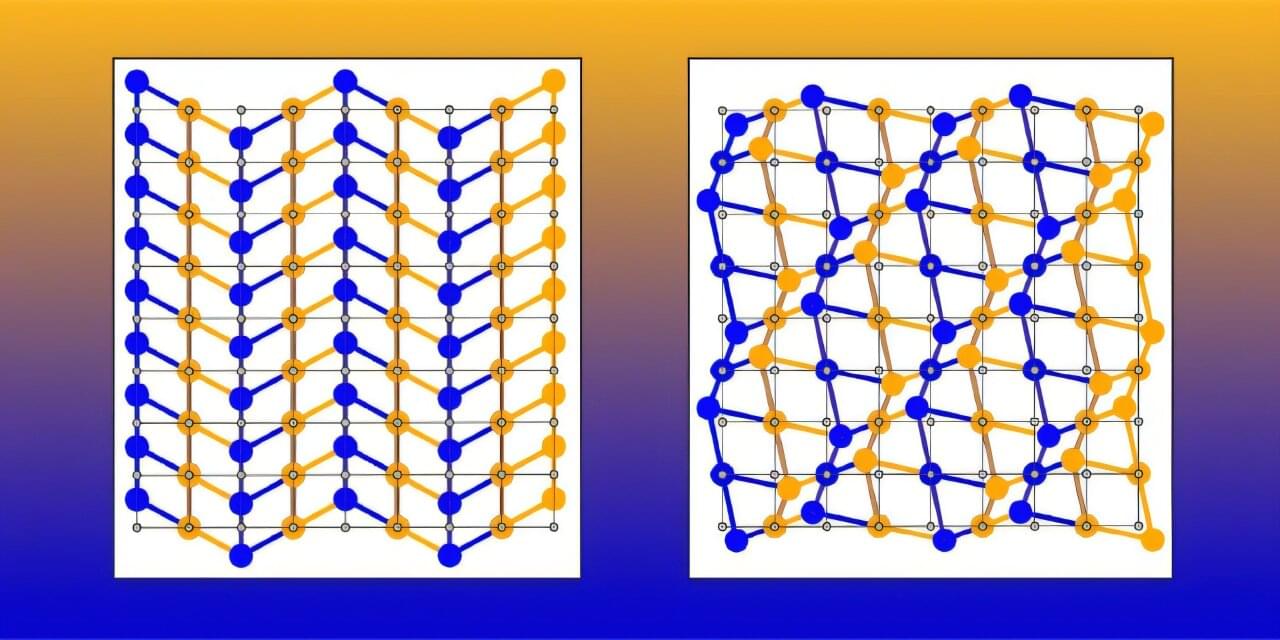
Electronic nematicity is a phase of some crystalline solids in which electrons’ collective properties, such as charge or spin densities, organize themselves into ordered patterns, lowering the crystal’s rotational symmetry. This phase is found across a wide range of diverse materials, making nematicity crucial to understanding emergent solid-state phenomena, such as unconventional superconductivity and magnetism.
Lately, experimentalists have encountered a hurdle to understanding nematicity: despite exhibiting nematic order at macroscopic scales, at the microscopic level, many nematic materials seem to exhibit disorder instead.
To address this seeming paradox, theorists at the University of Illinois Urbana-Champaign have invented a new way of looking at the interactions between nematicity and elasticity, incorporating aspects of elasticity theory, whose impacts on nematicity have previously been overlooked.