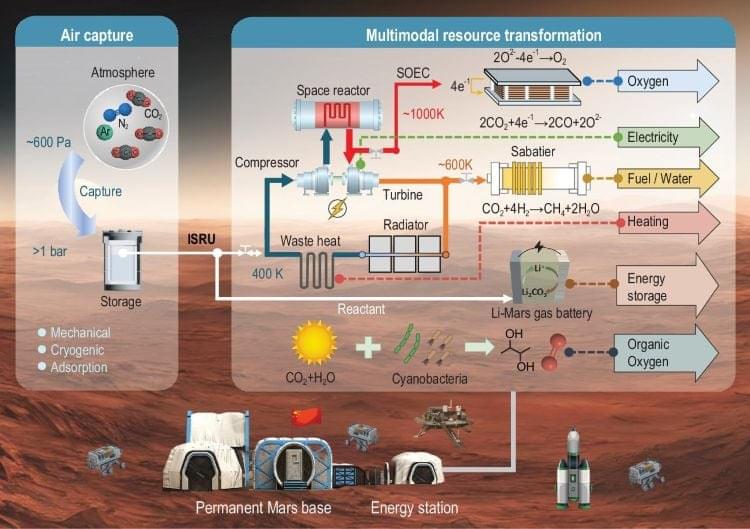
You’re in the lab analyzing Martian regolith samples within your cozy Mars habitat serving on the fifth human mission to Mars. The power within the habitat has been flowing flawlessly thanks to the MARS-MES (Mars Atmospheric Resource & Multimodal Energy System), including the general habitat lighting, science lab, sleeping quarters, exercise equipment, the virtual reality headsets the crew use for rest & relaxation, oxygen and fuel generation, and water. All this from converting the Martian atmosphere into workable electricity.
While this scenario might be decades away, scientists on Earth are working hard to make this concept a reality today. This includes a team of scientists from China who propose using a novel concept for converting the thin Martian atmosphere into heat and electricity. Their findings were recently published in National Science Review and could help revolutionize how electricity is produced on Mars through a process called in situ resource utilization (ISRU) without the need for power or power supplies being shipped from Earth.
For the study, the researchers propose several concepts for producing power and electricity on a future human Mars mission, including Martian air capture, in situ power generation and storage, and life support resources transformation. The team notes all these methods carry their own benefits and challenges while emphasizing the importance of using ISRU for powering future human Mars missions.