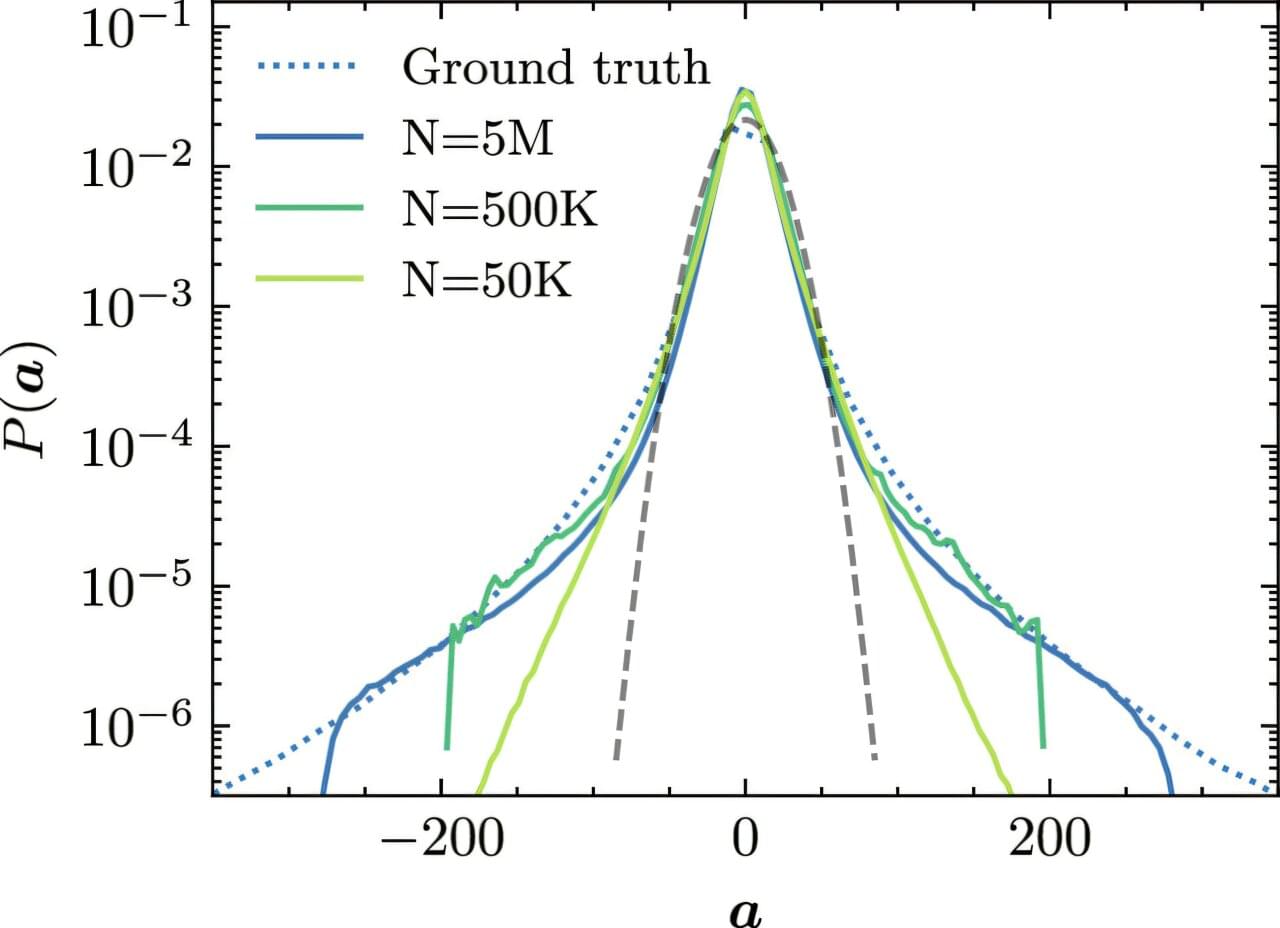
Whether the dust borne on the violent winds of a tornado or the sugar grains in a swirled cup of coffee, the behavior of particles carried along in turbulence is subject to some similarities—all of them difficult to predict at scale. As described in a recent publication in the Proceedings of the National Academy of Sciences, a research team led by Los Alamos National Laboratory scientists has developed a first-of-its-kind machine learning framework that models chaotic particle motions in a turbulent flow.
“Modeling turbulence is a big, open problem, and it’s probably the hardest problem in classical physics,” said Daniel Livescu, Los Alamos scientist and one of the leaders of the work. “A subset of that challenge is modeling particle motions within turbulence. To meet that challenge, our artificial intelligence approach offers an innovative theoretical construct tested with a real-world application.”
The team has developed and applied the first data-driven, auto-regressive machine learning framework to capture the dynamics of turbulence at scale. The research demonstrates that machine learning can overcome longstanding barriers in modeling chaotic particle motions.