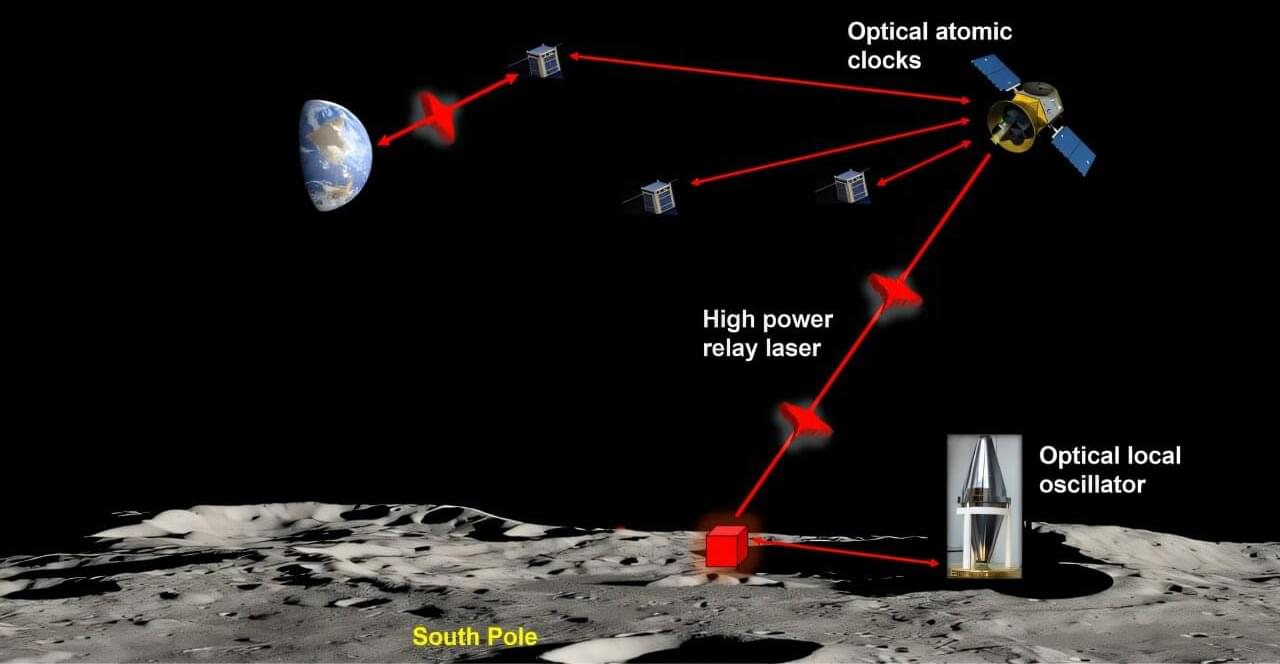
They rank among the darkest and coldest places in the solar system: Hundreds of lunar craters, many of them at the moon’s south pole, never receive direct sunlight and lie in permanent shadow. That’s exactly why physicist Jun Ye and his colleagues suggest that these craters are the perfect place to build a critical component for an ultrastable laser.
On the moon, a highly stable laser—a source of coherent light that has a nearly unwavering frequency, or color—could provide a master time signal and offer GPS-like lunar navigation, said Ye, who is affiliated with both the National Institute of Standards and Technology (NIST) and JILA, a joint institute of NIST and the University of Colorado Boulder. Multiple copies of these lunar lasers could precisely measure the distances between objects and potentially detect exotic physics phenomena such as ripples in spacetime.
To construct a lunar laser, astronauts would first install a key component known as an optical silicon cavity —a block of silicon that permits only certain frequencies of light to bounce back and forth between mirrors on each end of the block. The distance between the two mirrors determines the frequencies that are allowed to resonate; for a highly stable optical cavity, that distance, and therefore those frequencies, does not vary.