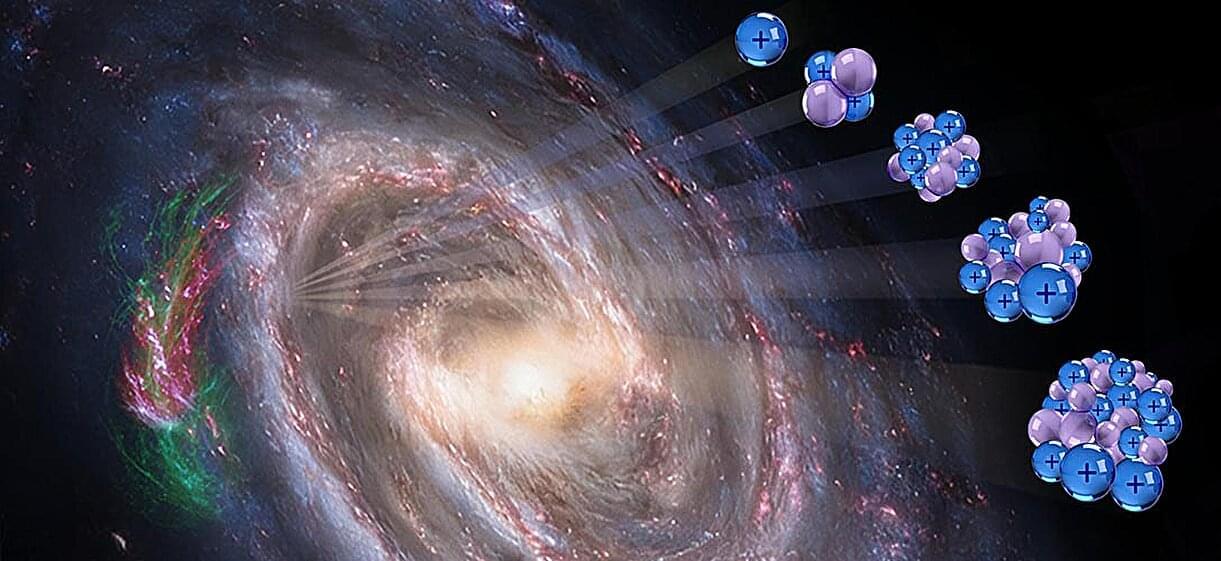
A century after their discovery, cosmic rays—particles of extreme energy originating from the far reaches of the universe—remain a mystery to scientists. The DAMPE (Dark Matter Particle Explorer) space telescope is tackling this phenomenon, particularly investigating the role that dark matter may play in their formation. This international mission, which includes the University of Geneva (UNIGE), has made a major breakthrough by highlighting a universal feature of these particles. The results are published in the journal Nature.
Cosmic rays are the most energetic particles observed in the universe, far surpassing the energies of particles produced by man-made accelerators on Earth. Their exact origin is still under study, and it is believed that they originate from extreme astrophysical phenomena, such as supernovae, black hole jets, or pulsars.
The DAMPE space telescope, launched in December 2015, aims to provide answers regarding the origin and nature of these cosmic rays. This space mission, with the astrophysics group from the Department of Nuclear and Particle Physics (DPNC) at the University of Geneva (UNIGE) being one of its main contributors, has made a crucial breakthrough. Through the analysis of high-precision measurements collected by the telescope, scientists have identified a universal feature in the energy spectra of primary cosmic ray nuclei, ranging from protons to iron.