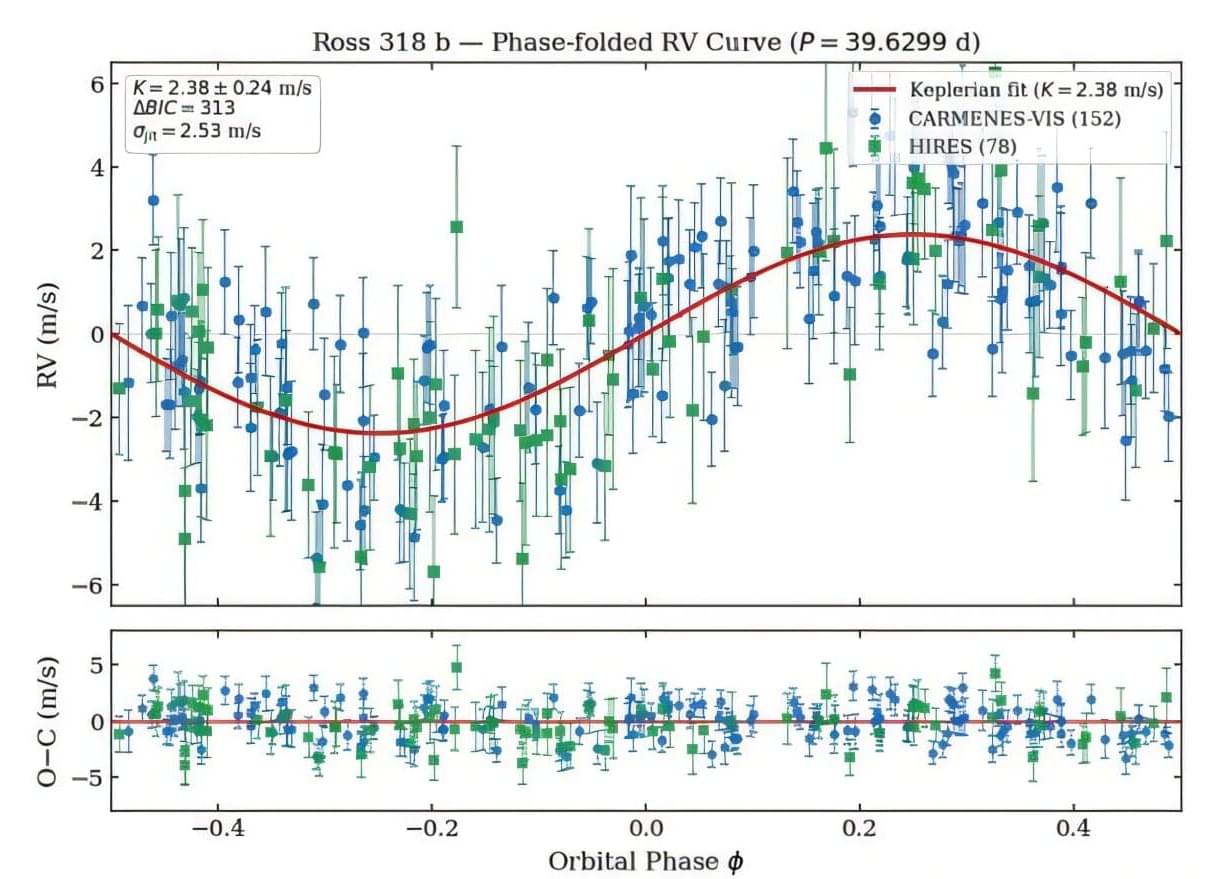
Astronomers from Italy and Brazil have investigated a nearby red dwarf star known as Ross 318 and have discovered an exoplanet orbiting this star, which is at least six times more massive than Earth. The discovery is reported in a research paper published May 11 on the arXiv preprint server.
Located just 28 light years away from Earth, Ross 318 (also known as Gliese 48, or TIC 379084450) is a red dwarf star of spectral type M3.5V. The star has an orbital period of approximately 51.5 days and an effective temperature of 3,450 K, and showcases strong magnetic activity, which poses a major challenge for exoplanet searches.
A team of astronomers led by Giuseppe Conzo from the amateur astronomy association Gruppo Astrofili Palidoro (GAP) decided to investigate Ross 318, hoping that amidst its magnetic activity, they could verify whether an alien world orbits this star. For this purpose, they conducted a systematic re-analysis of radial velocity (RV) data from the CARMENES spectrograph and decade-long High Resolution Echelle Spectrometer (HIRES) observations. Their study was complemented by data from the Transiting Exoplanet Survey Satellite (TESS).