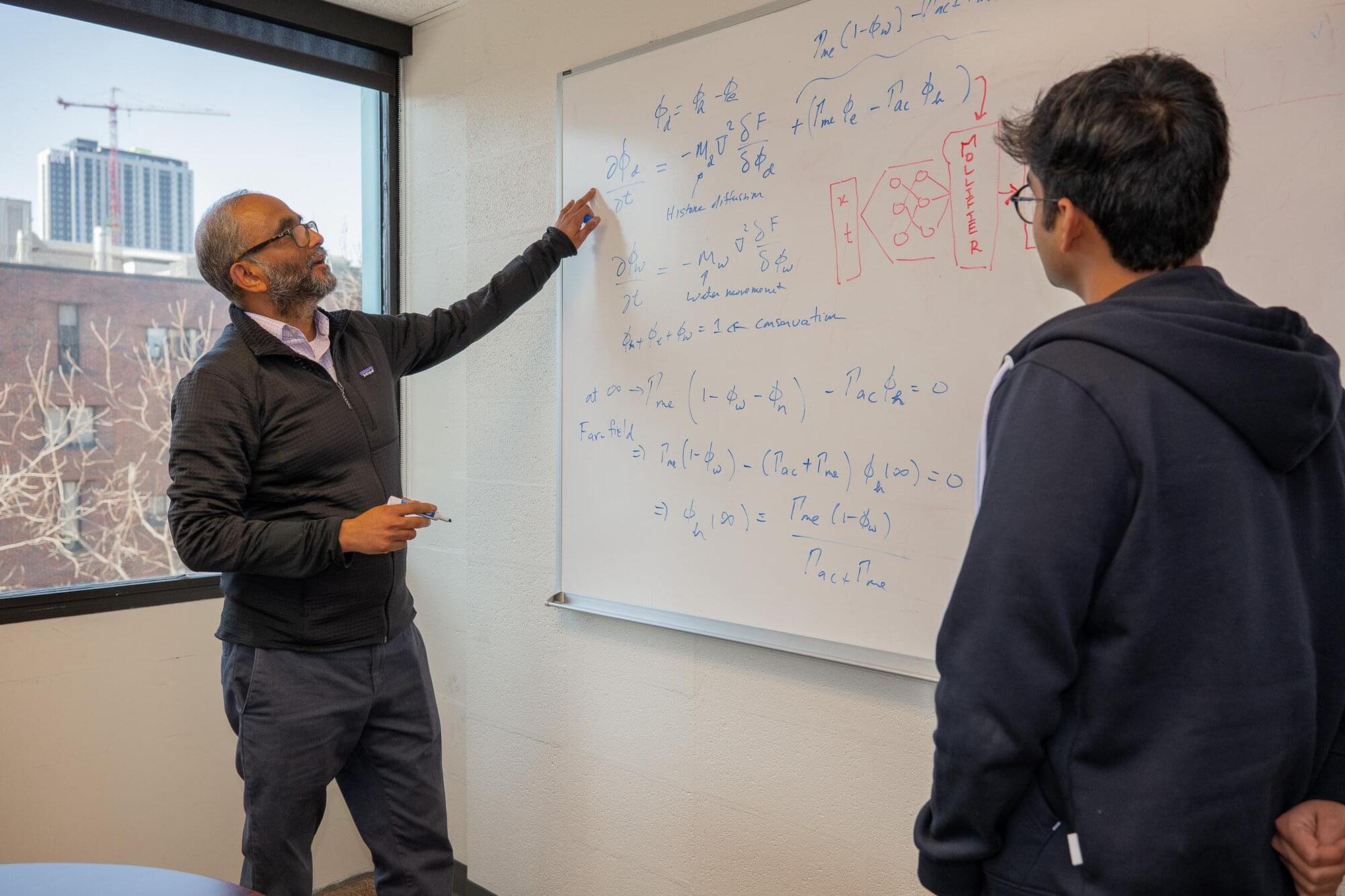
Penn Engineers have developed a new way to use AI to solve inverse partial differential equations (PDEs), a particularly challenging class of mathematical problems with broad implications for understanding the natural world.
The advance, which the researchers call “Mollifier Layers,” could benefit fields as varied as genetics and weather forecasting, because inverse PDEs help scientists work backward from observable patterns to infer the hidden dynamics that produced them.
“Solving an inverse problem is like looking at ripples in a pond and working backward to figure out where the pebble fell,” says Vivek Shenoy, Eduardo D. Glandt President’s Distinguished Professor in Materials Science and Engineering (MSE) and senior author of a study published in Transactions on Machine Learning Research (TMLR), which will be presented at the Conference on Neural Information Processing Systems (NeurIPS 2026). “You can see the effects clearly, but the real challenge is inferring the hidden cause.”