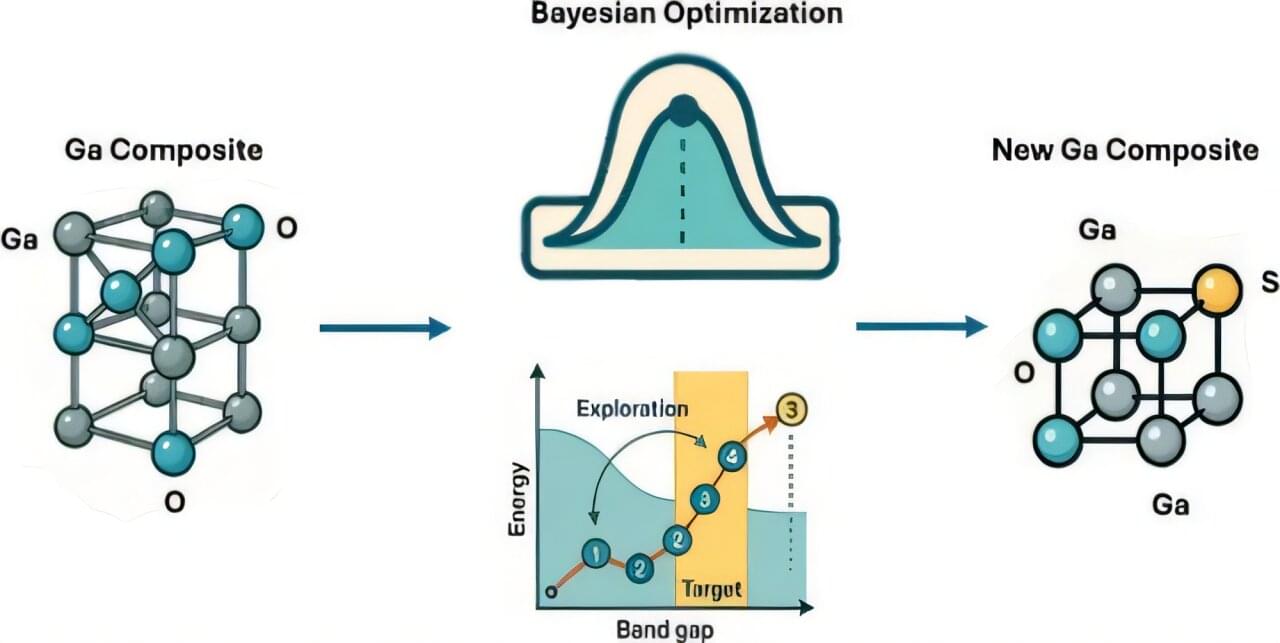
An international study team, led by Flinders University in collaboration with Khalifa University UAE, built the machine-learning platform to act like a “smart materials discovery engine,” which is capable of dramatically reducing the time spent on complex computer or lab experiments to test and find new materials for future semiconductors.
Semiconductors are used in high-tech applications from wearable electronics, communication systems and smartphones to medical and LED devices and solar panels.
“The challenge is that there are millions of possible material combinations, and testing them one by one in the laboratory or with complex computer simulations is extremely slow and expensive,” says Flinders University ARC Future Fellow Associate Professor Vi-Khanh Truong, lead author of a new article in ACS Materials Letters, titled “Bayesian optimization-guided discovery of gallium-containing semiconductors with targeted band gaps.”